Is a Bill of Sale the Same as a Title? Title vs Bill of Sale, Explained
Buyers hear both terms at once and it's easy to assume they're two names for the same paper. Is a bill of sale the same as a title? No, and mixing them up is one of the most common reasons a private car purchase goes wrong. The title is the state's proof of ownership; the bill of sale is the receipt for the deal. This guide explains what each one does, when you need both, the few cases where a bill of sale stands in for a title, and how to protect yourself.
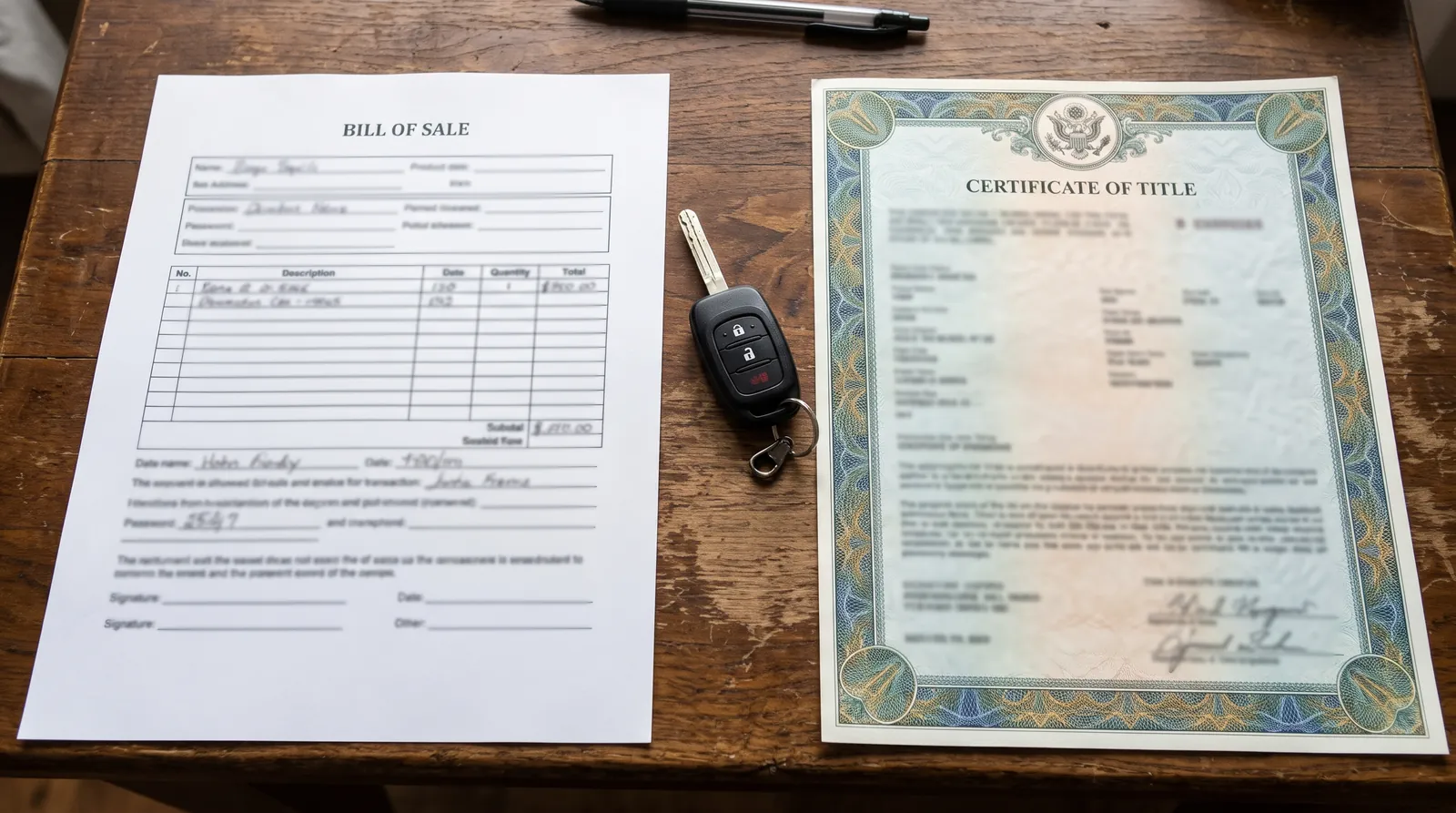
No. A title, issued by the state, proves who owns the vehicle. A bill of sale, written by the buyer and seller, records that a sale happened, for how much and when. For a titled car, the buyer needs the signed title to register it; the bill of sale backs it up. Only untitled vehicles transfer with a bill of sale alone.
Title vs bill of sale at a glance
| Certificate of title | Bill of sale | |
|---|---|---|
| Who creates it | The state motor vehicle agency | The buyer and seller |
| What it proves | Legal ownership | That a sale happened, and its terms |
| Key details | Owner, VIN, lienholder, brands, title number | Price, date, parties, vehicle, conditions |
| Needed to register a titled car? | Yes, signed over to the buyer | Sometimes, depending on the state |
| Can be replaced if lost? | Yes, by the state as a duplicate | Only if both parties sign a new one |
| Security features | Yes: special paper, seals, numbers | Usually none |
The difference in who creates each document is the heart of it. Anyone can write a bill of sale. Only the state can issue a title, and it keeps a matching record.
What a title does
A certificate of title is the official record of who owns a vehicle. It lists the owner or owners, the VIN, the year, make and model, any lender with a lien, and any brand such as salvage or rebuilt. When a car is sold, the seller signs the title over to the buyer, and the buyer takes it to the state to get a new title in their name. The state then cancels the old title and updates its records.
Because the state keeps the record, a title can be checked. A buyer can confirm the VIN, look for liens and brands, and in many states check the title's status online. Our guide to clean titles explains how.
What a bill of sale does
A bill of sale is a receipt for a private sale. It records who sold the car to whom, the date, the price, the vehicle's description and VIN, and any conditions such as "as is." Both parties sign it and keep a copy. It's useful for several things: proving when you stopped owning the car if a ticket or toll arrives later, showing the price for sales tax, and settling a dispute over what was agreed.
What it can't do, for a titled vehicle, is move ownership on the state's records. Our guide on how to write a bill of sale covers what to include, and our free bill of sale generator builds one in a few minutes.
When you need both
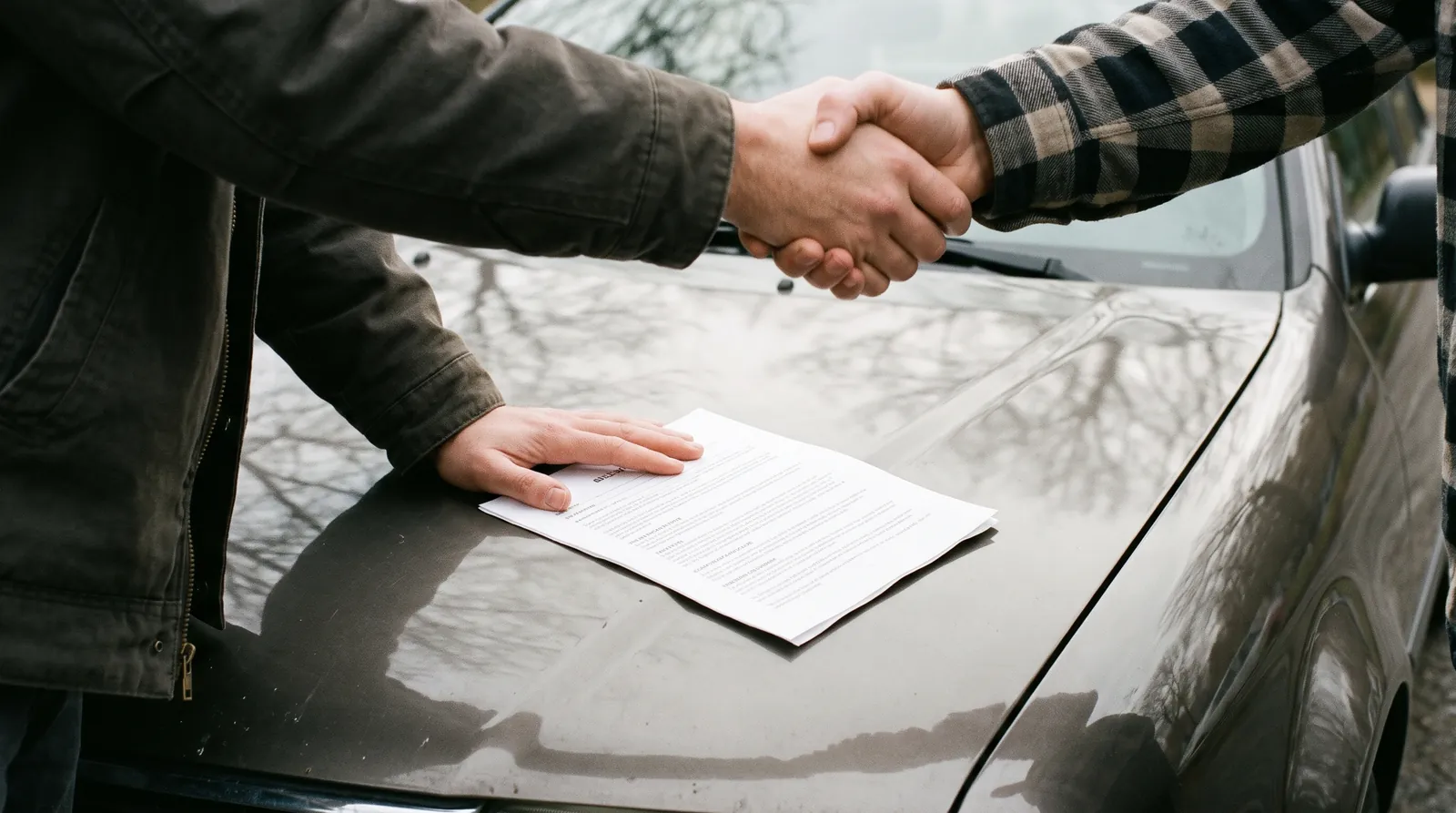
For a typical private sale of a titled car, you'll want both: the signed title so the buyer can register the car, and a bill of sale as the record of the deal. Some states make the bill of sale mandatory:
- Connecticut requires one to register a car.
- Washington requires one unless the price and date already appear on the title.
- Massachusetts needs one when the title has no space for the price, or for a vehicle that's exempt from titling because of its age.
- New York has its own bill of sale form, which the buyer signs too.
Even in states where it's optional, many county offices ask for one when the price isn't on the title, because they need it to calculate tax.
When a bill of sale stands in for a title
Some vehicles don't have titles at all, and for them, a bill of sale is the main proof of the sale:
- Older cars in some states. Georgia doesn't require titles for vehicles of model year 1985 or older; they're sold with a bill of sale. New York doesn't title vehicles of model year 1972 or older; they transfer with the transferable registration and a bill of sale.
- Small trailers and some boats, in states that don't title them.
- Off-road vehicles such as some dirt bikes and ATVs, depending on the state.
Even then, the buyer usually needs something else from the state, such as the old registration, and possibly an inspection, to register the vehicle. Our guide on registering a car without a title covers these exemptions and what happens when a car that should have a title doesn't.
If a seller offers only a bill of sale
For a car that should have a title, a seller who offers only a bill of sale is a warning sign. The car might be stolen, still owned by a lender, or have a title the seller can't produce because it's in someone else's name. A bill of sale signed by someone who doesn't own the car doesn't give you ownership, no matter how official it looks.
- Ask why there's no title. A lost title is fixable: the owner can request a duplicate before the sale.
- Check the VIN for theft and liens before paying.
- Compare the seller's ID with the name on the last registration.
- Wait for the title. If the seller is honest, they'll get the duplicate and sell then.
Our guide on replacing a lost car title shows the seller how to fix it.
If you have a title but no bill of sale
That's usually fine for registration in states that don't require a bill of sale, as long as the title is signed correctly and shows the price and date where your state asks for them. But the seller loses an easy record of the sale date, and the buyer loses a record of the price and any promises. Writing one takes five minutes, and it's worth doing even if the DMV doesn't ask.
Where registration fits in
A third document often gets mixed in: the registration. The title says who owns the car, the bill of sale records the sale, and the registration is the state's permission to drive it on public roads, renewed every year or two. A buyer needs the title to get a new registration in their name; the seller's registration doesn't transfer to the buyer in most states. Our guides on the registration card and how to register a car cover that part.
Which papers for which kind of sale
Gifts and family transfers
Giving a car to a relative still needs the title signed over, with "gift" or $0 where the price goes if your state allows that. Many states also want a gift affidavit or a bill of sale showing no money changed hands, so the tax office can apply a family exemption. Here, the bill of sale's job is to prove the price was zero, not to transfer ownership.
Selling to a dealer or scrapyard
A dealer that buys your car takes the title and usually prepares its own purchase paperwork, which works as the bill of sale. A licensed scrapyard also needs the title in most states, and many have a process for junking cars that never had one or whose title is lost. Ask the yard what it accepts before you tow the car there.
A car bought in another state
If you buy a car in one state and register it in another, your home state will want the out-of-state title signed over to you. A bill of sale helps with sales tax credit, since it shows what you paid and sometimes the tax you already paid in the other state. Our guide on buying a vehicle from out of state covers inspections and deadlines.
Why people mix them up
The confusion is understandable. Both documents name the buyer and seller, list the VIN, and get signed at the same moment, often on the same table. Some titles even have spaces for the price and date, which makes them look like a bill of sale. And some states print a bill of sale form on the back of the registration or title application. So when people ask is a bill of sale the same as a title, the honest answer is that they cover some of the same facts but do different legal jobs. If you remember that only the state issues a title, you won't confuse them again.
Is a bill of sale a legal document?
Yes, a signed bill of sale is a legal record of an agreement and can be used as evidence in a dispute or small claims case. It shows that money changed hands for a specific vehicle on a specific date. What it doesn't do is override the state's title records. If a dispute is about who owns a car, the title and the state's records usually carry more weight, and a court may be needed to change them.
Does either need a notary?
It depends on the state. Some states require the seller's signature on the title to be notarized, and a few require a notarized bill of sale for certain vehicles. Most don't require a notary for either. Our guide on where to sign a title lists notary states, and the bill of sale guide covers when a notary is needed for that document.
Private sale paperwork checklist
- Seller gives: the original title, signed in the right places; a lien release if there was a loan; a signed bill of sale; any odometer form your state uses.
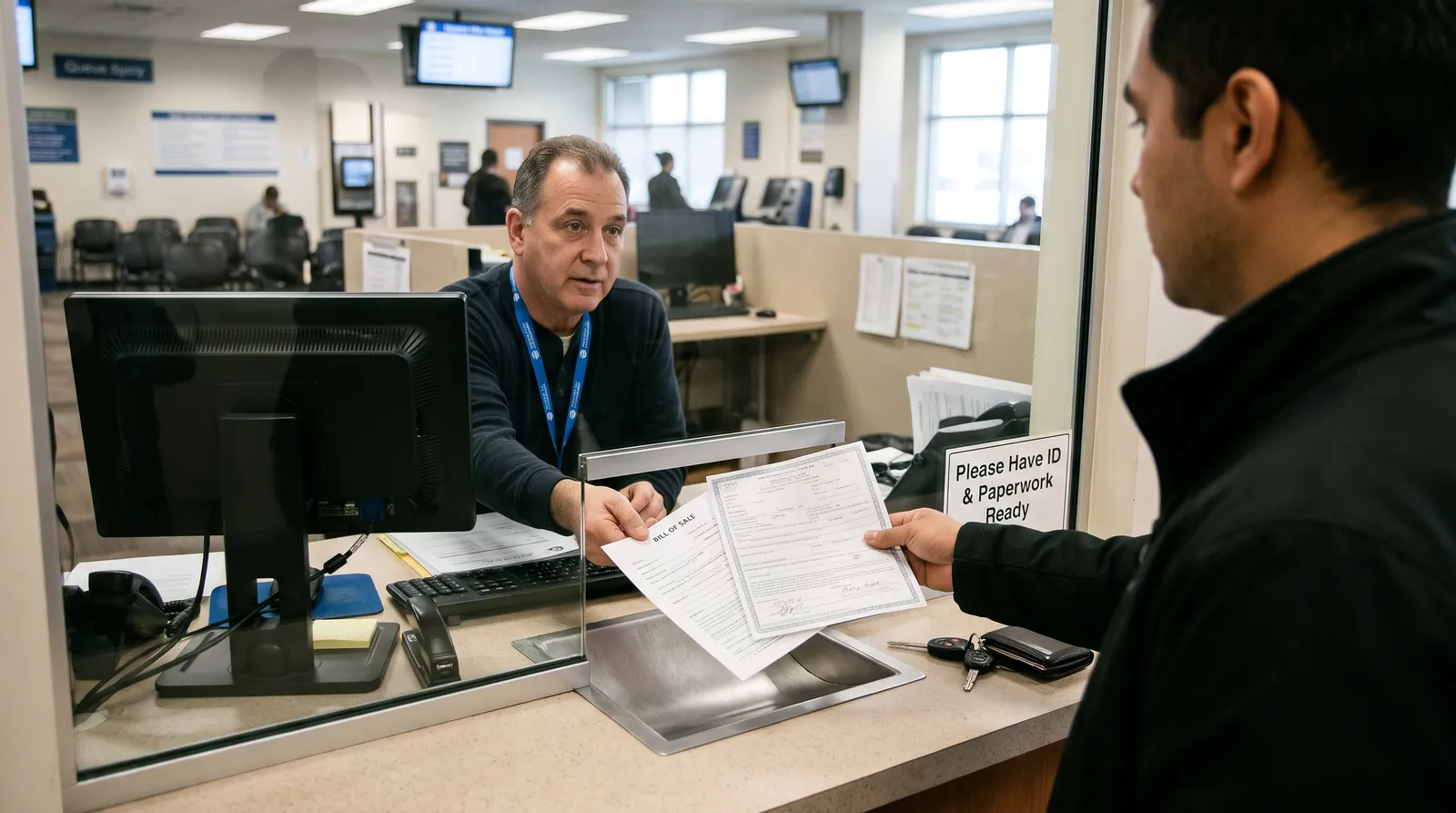
- Buyer brings to the state: the signed title, the bill of sale, proof of insurance, ID, the title application and payment.
- Seller files: a release of liability or notice of sale where your state has one, and keeps copies of everything.
Our guide on filling out a title when selling walks through the title fields.
Bill of sale vs title FAQ
Is a bill of sale the same as a title?
No. A title is issued by the state and proves who legally owns a vehicle. A bill of sale is a receipt written by the buyer and seller that records a sale: the price, date and vehicle. For most cars, you need the signed title to register the car, and the bill of sale supports it.
Can a bill of sale replace a title?
Only for vehicles the state doesn't title, such as Georgia vehicles of model year 1985 or older, or New York vehicles of model year 1972 or older, which use a transferable registration with a bill of sale. For a vehicle that should have a title, a bill of sale alone usually isn't enough.
Do I need both a title and a bill of sale?
Often. The title is always required for a titled vehicle. A bill of sale is required in some states, such as Connecticut for registration, and in Washington unless the price and date are already on the title. Even where it's optional, it's a useful record.
Who issues a title and who writes a bill of sale?
The state motor vehicle agency issues the title. The buyer and seller write and sign the bill of sale themselves, on a state form or their own document.
Sources
- Georgia DOR: Casual sale title and registration
- New York DMV: Proof of ownership
- Connecticut DMV: Bill of sale
- Washington Department of Licensing
This guide is general information, not legal advice. Your state's motor vehicle agency decides which documents it accepts.