Vehicle Registration Card Explained: What It Shows and Where the Number Is
Your vehicle registration card is the small document that proves your car is registered right now. It's the one an officer asks for at a traffic stop and the one forms ask you to copy numbers from. This guide explains what a vehicle registration card looks like, which number on it is the registration number, and what to do if you lose it.
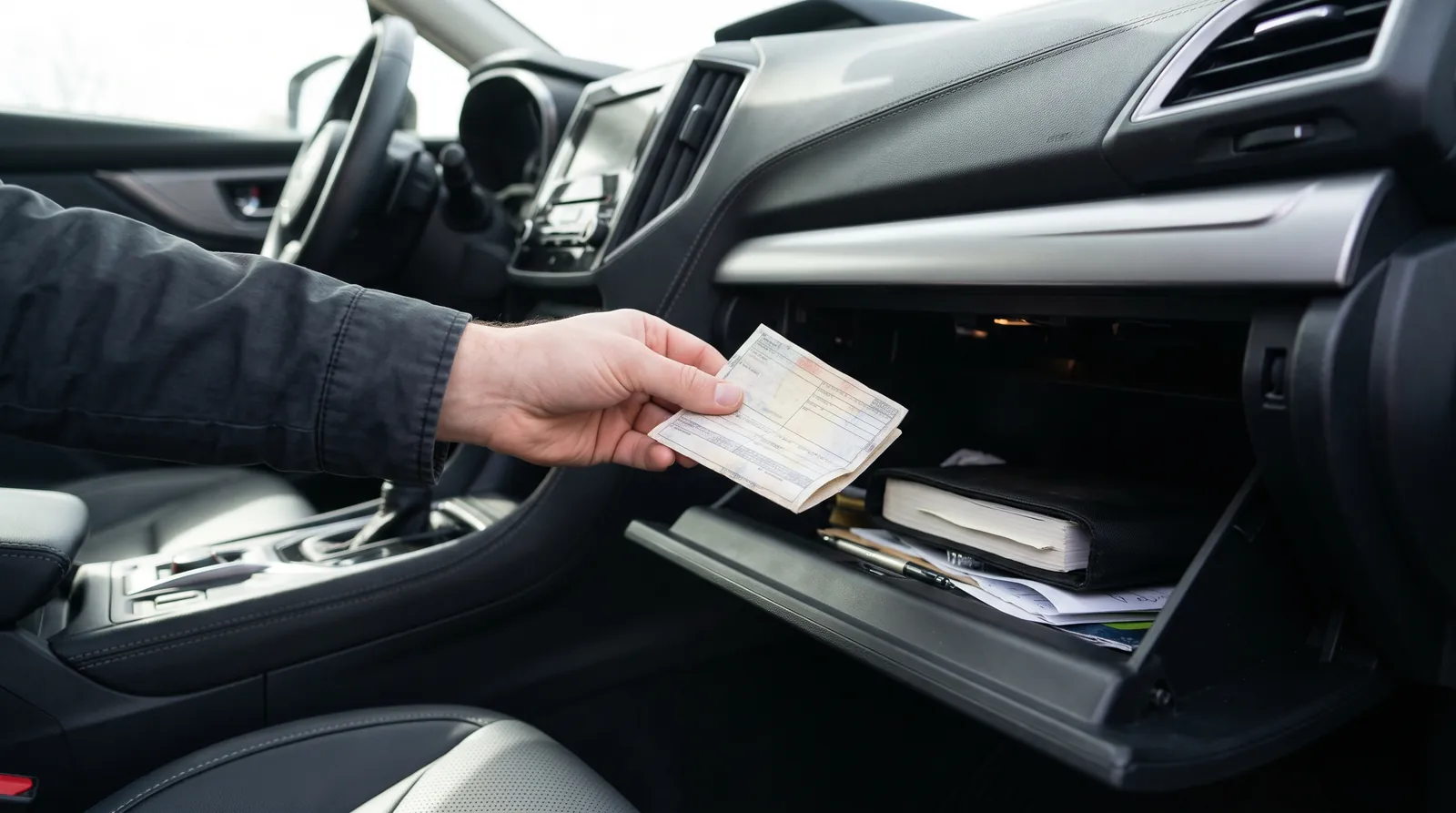
The registration card shows who the car is registered to, its plate number, VIN, description and expiration date. In many states the "registration number" is the plate number; some print a separate document number. Keep the card in the car, keep the title at home, and request a duplicate from your state if the card goes missing.
What a vehicle registration card is
When a state registers a vehicle, it records that the car may be driven on public roads until a certain date, and it gives the owner proof: the plate, a sticker, and a registration card. The card is the paper (or digital) part of that proof. It's renewed on the same schedule as the registration, every year or two in most states, and each renewal brings a new card with a new expiration date.
Most states require you to carry it, or a digital version where that's allowed, whenever you drive. It's also the document that proves your plate belongs to your car if there's ever a question, and the quickest place to find the details a form asks for.
What does a vehicle registration card look like?
It's usually a small paper card or strip, often printed as part of a renewal notice and torn off along a perforation. Designs vary by state, but a vehicle registration paper nearly always shows the same core information:
- the registered owner's name and address;
- the plate number;
- the vehicle identification number (VIN);
- the year, make, model and often body type and color;
- the date the registration expires, and sometimes the date it was issued;
- the vehicle's class or weight for trucks and trailers;
- the fees paid, in some states;
- a registration, document or control number, in some states.
We don't publish a photo of a real vehicle registration, since a clear image of someone's card is exactly what fraud starts with, and the layout differs from state to state anyway. If you want to know what a car registration paper looks like in your state, the agency's renewal page usually shows a sample, and your own card is the best reference.
An example of vehicle registration details
Here's how the information on a typical card reads, using made-up details:
Registered owner: Jordan Lee, 12 Maple Street, Springfield. Plate: ABC1234. VIN: 1HGCM82633A004352. 2019 Honda Accord, 4-door sedan, gray. Valid through: 06/30/2027. Class: passenger. Fees paid: shown in the lower corner.
Not every state shows every line, and some add more, such as the county of registration or the insurance company. But if you can find the plate, the VIN and the expiration date, you can find almost anything a form will ask for.
Where is the vehicle registration number on the registration?
This trips up a lot of people, because "registration number" means different things in different states:
- In many states, it's the plate number. The plate is the registration identifier, so when a form says registration number, it wants the plate. It's usually printed prominently near the top of the card.
- Some states print a separate number, labeled document number, registration number, control number or certificate number. If your card has one of these labels, that's the number a form asking for the "registration number" usually means.
- It isn't the VIN, which identifies the car itself and never changes, and it isn't the title number, which belongs to the ownership certificate.
If a form isn't clear, look at what it asks for next to the number. A request for the plate number and the last digits of the VIN, like California's online replacement form, tells you the plate is the key identifier in that state.
Where is the registration number on a car?
On the car itself, the registration is shown by the plate and its sticker. The sticker usually shows the expiration month and year, and in some states a small serial number; our registration sticker guide explains where it goes. The plate number is the registration number for most purposes. There's no separate registration number stamped anywhere on the car; the numbers stamped on the car are the VIN and, on many models, part numbers.
Where do I find my vehicle registration number without the card?
- Your renewal notice or receipt, paper or email.
- Your online account with the state's motor vehicle agency, if you've set one up.
- Your insurance card or app, which usually shows the plate and VIN.
- The plate itself, if the plate number is what you need.
- The agency, which can confirm your own vehicle registration info once you prove who you are.
Registration card vs title vs insurance card
| Document | What it proves | Where to keep it |
|---|---|---|
| Registration card | The car is currently registered to drive | In the car |
| Insurance card | The car is insured | In the car or on your phone |
| Title | Who owns the car | At home, somewhere safe |
The one people get wrong is the title. Keeping it in the glove box means a thief who takes the car also takes the document needed to sell it. Keep the registration card in the car, and the title at home. Our guide on whether to keep your registration in your car covers the state rules and privacy tips.
When you get a new registration card
A new card arrives every time something on the registration changes. The obvious one is renewal: each time you renew, the state issues a card with the new expiration date, and the old card stops being valid proof even though it looks the same. You'll also get a new card when you get new plates, when you transfer plates to another car, and when you add or remove an owner. An address change works differently from state to state: some send a new card, while others, such as New York, just update the record until your next renewal; see our guide to changing the address on your registration. Throw the old card away once the new one is in the car, so you never hand an officer an expired one by mistake.
If you renewed online and the card hasn't arrived, many states let you print a temporary receipt, and that receipt usually counts as proof until the card comes. Keep it with your insurance card.
Check your card for errors
Take a minute with a new card. Compare the VIN on it with the VIN on the car and the title, check that your name is spelled as it is on your license, and make sure the address is current. A wrong VIN causes trouble at the next sale or inspection, and a wrong address means renewal notices, toll bills and recall letters go somewhere else. Agencies fix errors on the record, usually with a short form and, sometimes, a small fee for a corrected card, as in Illinois.
Registration cards for trucks and trailers
Trucks, trailers and commercial vehicles have registration cards too, with extra details such as the registered weight or the vehicle class. A truck that runs between states under the International Registration Plan carries a cab card instead, which lists every state the truck is registered to travel in and the weight allowed in each. Our commercial vehicle checker explains when a truck needs IRP. A trailer usually has its own registration card, separate from the vehicle that tows it, so keep both cards in the towing vehicle.
Lost certificate of registration: how to get a duplicate
Every state replaces a lost or damaged registration card, usually cheaply and often online. A few examples from the agencies' pages:
- Illinois: a duplicate registration card costs $3. Apply with the Application for Vehicle Transaction(s), form VSD 190, by mail to Springfield or at a Secretary of State facility. A corrected card after a name or address change is also $3.
- California: request a replacement online if the card was lost, stolen or damaged, using the plate number and the last five digits of the VIN, or use form REG 156. The DMV mails it within 14 days to the address on record, so update your address first if you've moved.
- New Mexico: a duplicate registration certificate costs $3.50.
Lost your Illinois vehicle registration, or anyone else's state? Search the agency's site for "duplicate registration"; it's almost always a short form and a small fee. Until the replacement arrives, keep your renewal receipt in the car.
Digital registrations
Some states are moving away from paper. Since October 1, 2026, North Carolina issues digital registrations instead of stickers and printed cards, and your registration lives in NCDMV's records and its online portal. Other states let you show proof of registration or insurance on your phone. Check your state's rules before you rely on a phone; where paper is still required, a dead battery isn't an excuse.
Who can see your vehicle registration info?
Your registration record links your name and address to your plate, so it's protected. Under the federal Driver's Privacy Protection Act, the state releases those personal details only for permitted uses, such as insurance claims, court cases or law enforcement. Anyone can see your plate number on the road, but a stranger can't legally get your address from it. Our license plate lookup guide explains what each state releases.
Registration card FAQ
Where is the registration number on a vehicle registration card?
In many states the registration number is simply the plate number, printed near the top of the card. Some states also print a separate registration, document or control number. Check the labels on your card; the VIN and the title number are different numbers.
What does a vehicle registration card look like?
Usually a small paper card or strip, often torn from a renewal notice, showing the owner's name and address, the plate number, the VIN, the year, make and model, and the expiration date. Some states now issue digital registrations instead.
How do I replace a lost registration card?
Request a duplicate from your state's motor vehicle agency, online where offered. Illinois charges $3 on form VSD 190; California lets owners request one online or on form REG 156 and mails it within 14 days.
Is the registration card the same as the title?
No. The title proves ownership and stays at home. The registration card proves the car is currently registered to drive on public roads and stays with the car.
Sources
- Illinois Secretary of State: Vehicle services FAQ
- California DMV: Replace your registration card or sticker online
- New Mexico MVD: Lost registration or plate
- NCDMV: Digital vehicle registration
This guide is general information. Your state's motor vehicle agency decides what its registration card shows and whether a digital version is accepted.