"Where find VIN?" is one of the most common questions people type when a form asks for it, and the answer is reassuringly consistent. Federal rules tell manufacturers exactly where to put it, so once you know where to look on one car, you know where to look on almost all of them. The same goes for trailers, motorcycles and boats, each with their own rule.
What is a VIN number on a car?
A vehicle identification number is a 17-character code that identifies one specific vehicle. Under 49 CFR 565, every VIN has 17 characters, uses only capital letters and digits (never I, O or Q), and includes a check digit in position 9. No two vehicles built in a 60-year period from the 1980 model year can share one. The VIN tells you the manufacturer, the vehicle's main attributes, the model year, the assembly plant and a serial number; our VIN decoder reads all of that from NHTSA's data.
What the 17 characters mean
49 CFR 565.15 splits every VIN into four sections. Read left to right:
| Positions | Section | What it tells you |
|---|---|---|
| 1–3 | World manufacturer identifier (WMI) | The maker and the country it's registered in. Small manufacturers building fewer than 1,000 vehicles a year use a 9 in position 3 and identify themselves in positions 12–14. |
| 4–8 | Vehicle descriptor section | Attributes such as the model line, body type, engine and restraint system, coded by the manufacturer. |
| 9 | Check digit | A number (or X) calculated from the other 16 characters, so a typo shows up. |
| 10 | Model year | A letter or digit for the model year, explained below. |
| 11 | Plant code | The factory that built the vehicle. |
| 12–17 | Production sequence | The serial number that makes this VIN unique. |
How to read the model year from a VIN
The 10th character follows a fixed cycle that skips the letters I, O, Q, U and Z and the digit 0, so it can't be confused with a number. The cycle repeats every 30 years, which is why a decoder also looks at the other characters to tell a 1996 from a 2026. Recent years:
| Code | Year | Code | Year | Code | Year |
|---|---|---|---|---|---|
| A | 2010 | H | 2017 | R | 2024 |
| B | 2011 | J | 2018 | S | 2025 |
| C | 2012 | K | 2019 | T | 2026 |
| D | 2013 | L | 2020 | V | 2027 |
| E | 2014 | M | 2021 | W | 2028 |
| F | 2015 | N | 2022 | X | 2029 |
| G | 2016 | P | 2023 | Y | 2030 |
So a VIN with an S in the 10th position is a 2025 model, even if the car was built in 2024. The model year is what goes on the title and the bill of sale, not the build date on the door label.
Older cars and other places the VIN appears
The 17-character standard began with the 1981 model year. Cars built before that carry shorter serial numbers that each manufacturer formatted its own way, so a modern decoder or check-digit test won't work on them; the title and the number stamped on the car are what matter. On many newer models, the VIN or a short version of it also appears on major parts such as the engine and transmission, under federal theft-prevention marking rules. That's why a car's VIN number on the dashboard, the door label and the paperwork should always match, and why a mismatch deserves a closer look before you buy.
Where can I find a VIN number on a car?
For passenger cars, SUVs, pickups and vans up to 10,000 pounds, federal rules say the VIN has to be inside the passenger compartment and readable through the glass, without moving anything, by someone standing outside next to the left windshield pillar. In practice, that means a small plate on the dashboard at the bottom of the windshield on the driver's side. Each character must be at least 4 mm tall.

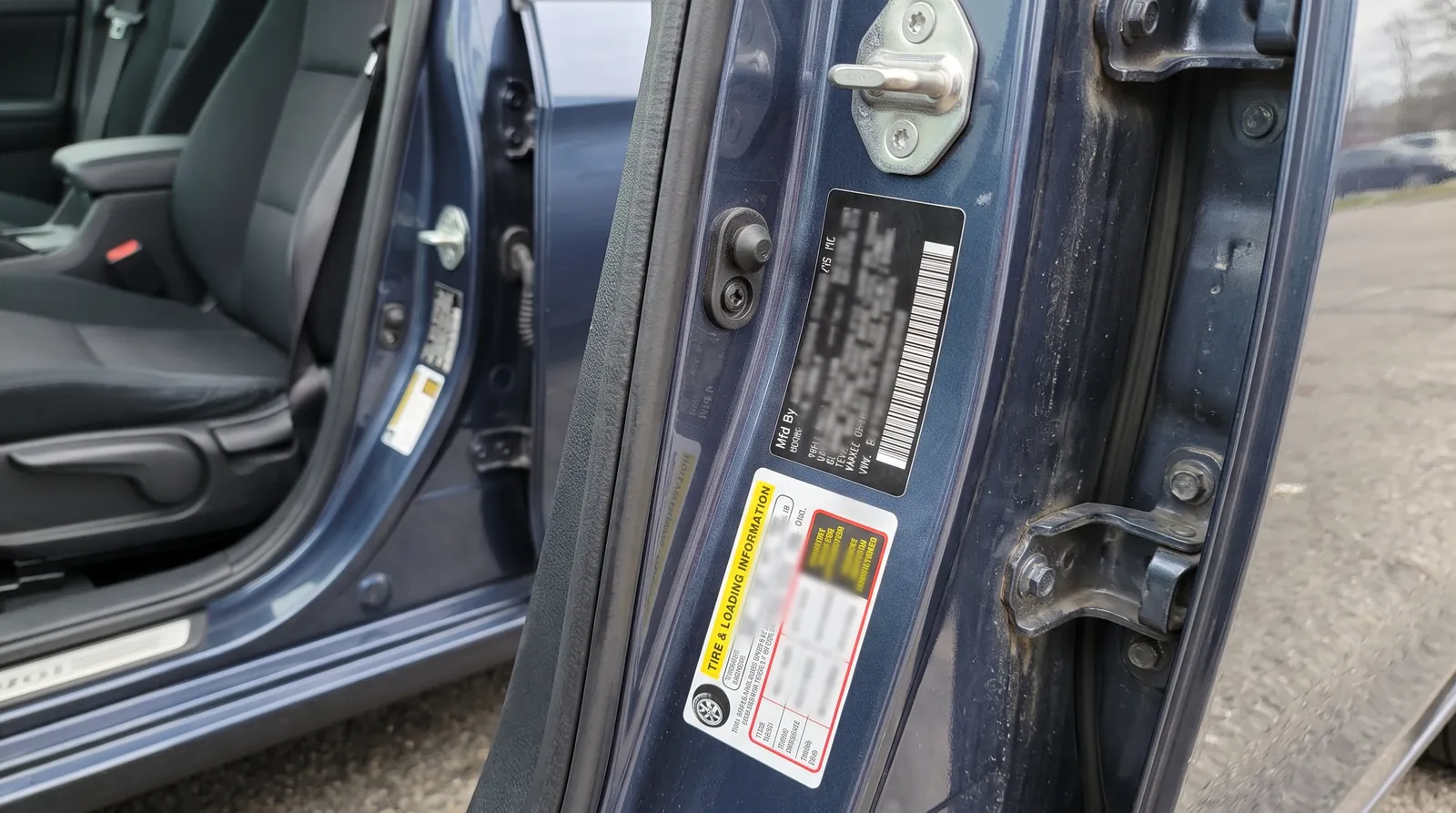
The second place to look is the certification label, which manufacturers must fix to the hinge pillar, the door-latch post or the door edge next to the driver's seat. Open the driver's door and look at the edges. And of course the VIN number is on your title, registration card and insurance card.
So where can I find the VIN number fastest? Look through the windshield from the outside. If you need to know where to find a VIN number on paperwork instead, start with your insurance card.
Trailer VIN location
So where do you find a trailer VIN? The certification label goes on the forward half of the left side, where it can be read from outside. Many manufacturers also stamp the trailer VIN number into the tongue or the front of the frame. Homemade trailers may carry a state-assigned number instead. A travel trailer VIN follows the same rule; look near the front on the left side, often by the hitch. For a camper VIN number on a slide-in truck camper, check the camper body itself and its paperwork, since it isn't attached to the truck's VIN.
Boat trailers are road vehicles, so a boat trailer VIN is separate from the boat's hull number. If you're doing a boat trailer VIN lookup, use the trailer's 17-character VIN in our decoder, not the hull ID.
Motorhome VIN location
A motorhome is a motor vehicle, so its RV VIN follows the car-and-truck rules: through the windshield on the driver's side and on the driver's door pillar label. Motorhomes are often built on a separate chassis, so the VIN you'll see on the title is the chassis VIN.
Motorcycle VIN location
Federal rules put the motorcycle certification label on a permanent part of the frame as close as practical to where the steering post meets the handlebars. The VIN itself is usually stamped on the steering head, the tube at the front of the frame. If you're wondering where to find the VIN number on a motorcycle, turn the handlebars to one side and look on the right or left of the steering head. That's the spot on most motorcycles, and a dirt bike VIN is usually in the same place.
ATVs, UTVs and snowmobiles
Off-road machines aren't built for public roads, so they don't follow the windshield rule. An ATV VIN number is typically stamped on the frame, and a snowmobile VIN number is usually on the tunnel. Newer machines generally use 17-character VINs, which a VIN decoder can read for an ATV in many cases. Older machines and golf carts may have shorter serial numbers.
Boats: look up a boat by its hull ID, not a VIN
Boats don't have VINs; they have a 12-character hull identification number (HIN). Under 33 CFR 181.29, every boat carries two:
- The primary HIN on the starboard (right) outboard side of the transom, within two inches of the top. Boats without a transom carry it on the starboard side of the hull within a foot of the stern; pontoon boats on the aft crossbeam near the starboard hull.
- A duplicate HIN in an unexposed place inside the boat or under a fitting, so a removed primary number can still be checked.
To look up a boat by VIN, then, you really look it up by HIN. The first three characters are the builder's Manufacturer Identification Code, and the U.S. Coast Guard's boating site lets you search MICs by company name or code, and search recalls by MIC. For a boat documented with the Coast Guard, its documentation search accepts a HIN. Beyond that, a boat HIN lookup for ownership goes through your state's boating agency, under the same privacy rules as cars. Our boat bill of sale checks a HIN's layout as you type.
Searching for a boat's VIN, free or paid, by number or with a lookup tool, always ends at the HIN and those sources. For a boat trailer, searching by VIN number does work, because the trailer has a real 17-character VIN.
If the VIN is hard to read
Windshield plates fade, door labels peel, and frame stampings rust. Before you guess at a character, compare every location you can find: the dashboard plate, the door label, the title and the registration should all agree. Clean a stamped number gently with a soft brush rather than scraping it, and photograph it in angled light, which makes stamped characters stand out. If two sources disagree, trust neither until you know why; a mismatch is exactly what title clerks and inspectors look for, and it's worth settling before a sale.
How the VIN check digit works
The checker above shows the full calculation. Each letter is given a number value, each of the 17 positions has a weight (8, 7, 6, 5, 4, 3, 2, 10, 0, 9, 8, 7, 6, 5, 4, 3, 2), the values are multiplied by the weights and added up, and the total is divided by 11. The remainder is the check digit; a remainder of 10 is written as X. If the 9th character doesn't match, at least one character is wrong. It's the quickest way to catch a typo before it ends up on a title application or a bill of sale.
VIN plates: what's legal
Questions about a custom VIN plate usually come from restorers. The rules are strict: federal regulations require the VIN to be on a part not designed to be removed, or on a plate permanently attached so that removal is obvious, and tampering with or replacing vehicle VIN plates without authorization is illegal. If a plate is damaged or missing, ask your state's motor vehicle agency about an assigned replacement rather than ordering a reproduction.
VIN location FAQ
Where is the VIN on a car?
Inside the windshield on the driver's side, readable from outside next to the left windshield pillar, as federal rules require for cars and light trucks. It's also on the certification label on the driver's door pillar, and on the title, registration and insurance card. If your new state wants the VIN inspected before it issues a title, see VIN verification by state.
Where is the VIN on a trailer?
The certification label on a trailer must be on the forward half of the left side, readable from outside. Many trailers also have the VIN stamped on the tongue or frame.
Do boats have a VIN?
No. Boats have a 12-character hull identification number (HIN). The main one is on the upper starboard side of the transom, and a duplicate is hidden inside the boat.
What is the VIN check digit?
The 9th character, calculated from the other 16 using fixed weights and the remainder after dividing by 11. If one character is mistyped, the check digit usually won't match.
Sources
- eCFR: 49 CFR Part 565, Vehicle Identification Number requirements
- eCFR: 49 CFR Part 541, Federal motor vehicle theft prevention standard
- eCFR: 49 CFR 567.4, Certification label locations
- eCFR: 33 CFR 181 Subpart C, Hull identification numbers
- U.S. Coast Guard: Manufacturer Identification Code search
- U.S. Coast Guard: Vessel documentation status search
Locations can vary slightly by manufacturer; the paperwork always shows the official number.