Every license plate leads back to a registration record at a state motor vehicle agency, and that record holds the owner's name and address. So it's natural to assume a plate search should be easy. It isn't, and that's deliberate. Since the late 1990s, federal law has kept those records private unless the person asking has a reason the law recognizes. We built this guide so you can find the legal route quickly instead of paying a website for something it can't honestly deliver. Think of it as a license plate lookup, free to use, that tells you the truth about what's possible.
The law behind every license plate lookup
The Driver's Privacy Protection Act (DPPA), 18 U.S.C. 2721–2725, says a state department of motor vehicles may not knowingly disclose personal information from a motor vehicle record except for the uses listed in the law. Personal information includes the owner's name, address and phone number. That's why a check of a license plate owner isn't something any member of the public can do with a quick search.
The law has teeth on both sides. A person who knowingly obtains, discloses or uses personal information from a motor vehicle record for a purpose the law doesn't permit can be sued by the owner. Under 18 U.S.C. 2724, the court can award actual damages of not less than $2,500, punitive damages for willful or reckless violations, and attorneys' fees. Several states add their own penalties: New Jersey makes knowingly obtaining or disclosing record information for a non-permitted use a fourth-degree crime, and Texas treats falsifying a record request as a third-degree felony.
What a free license plate lookup can and can't show
Strip away the owner's personal information and a plate record still holds vehicle details, which some agencies treat differently. Texas, for example, says it may provide non-personal information such as the year, make, model, weight, and title number and status. Georgia offers a VIN-based printout with no owner names. Ohio's registration record shows current registration only, not history.
That's the reality behind every license plate lookup free offer: a lawful, low-cost lookup can usually tell you about the vehicle, not the person. If you're searching for a free lookup of a license plate owner, the honest answer is that no state gives that out for curiosity, and our guide says so when you choose that reason. A reverse license plate lookup of the owner is possible only through a permitted use, which is what the tool above sorts out.
The permitted uses, in plain English
The DPPA lists the purposes for which personal information may be released. Summarized from 18 U.S.C. 2721(b):
- Government agencies, including courts and police, carrying out their functions.
- Vehicle and driver safety and theft, emissions, recalls and similar manufacturer matters.
- Legitimate businesses verifying information an individual gave them, and correcting it to prevent fraud or recover a debt.
- Court and agency proceedings, including serving legal papers and enforcing judgments.
- Research and statistics, as long as nobody is contacted or identified.
- Insurers, for claims, anti-fraud work, rating and underwriting.
- Notices to owners of towed or impounded vehicles.
- Licensed private investigators and security services, for one of the other permitted purposes.
- Employers verifying a commercial driver's license.
- Private toll facilities.
- With the person's consent, in the ways the law describes.
Notice what's missing: finding out who owns a car that cut you off, or checking up on a neighbor. For those, the route is the police if there's a real problem, and nothing at all if there isn't.
The right route for common situations
- Crash or hit-and-run: report it to the police with the plate number, then give the plate and report number to your insurer. Both are allowed to identify the owner.
- Car abandoned on your property: call your local police non-emergency line or a licensed towing company. Towing notices are a permitted use.
- Buying a used car: you don't need the owner's name. Check the seller's ID against the title, check the VIN for recalls, and order a title history from an approved NMVTIS provider.
- Your own vehicle: you can always request your own record with your state's form.
Every name for the same search
People phrase this search a dozen ways, and the answer depends on what's behind the words, not the words themselves:
- "License plate lookup free" or "lookup plate number": a free lookup can tell you about the vehicle in some states, but not about the owner.
- Reverse lookups: a reverse license plate lookup asks for the owner's identity, which requires a permitted use. A licence plate number reverse lookup, with the British spelling, runs into exactly the same rules.
- "Look up people by license plate": the DPPA exists precisely to stop this for anyone without a permitted use.
- "Bumper license plate lookup" or "check number plate": usually someone who saw a plate on a bumper and wants to know whose it is. Unless there's a crash, a crime or a towing situation, the agency won't say.
- Every other state: the same federal rules apply everywhere, whatever the spelling or wording of the search; only the form and fee change. Pick the state in the tool to see them.
Put simply, a license plate lookup free of charge and free of rules doesn't exist through official channels. A lawful one costs a few dollars and needs a reason.
Vehicle record request forms and fees by state
If you do qualify, each state has its own request form and fee. This table summarizes them; choose your state in the tool above for the full details and the official link.
| State | Form or service | Fee |
|---|---|---|
| Alabama | Records Request Portal (online, for authorized requesters) | Not stated |
| Alaska | Vehicle research request (Form 851), or online through DMV Online Services | $10 by paper, $5 electronic |
| Arizona | Motor Vehicle Record Request (form 46-4416) | $3 uncertified by mail or in office, $5 certified |
| Arkansas | Ask the Office of Motor Vehicle (no published individual form) | Not stated |
| California | Request for Record Information (INF 70) | $5 per record by mail ($2 electronic) |
| Colorado | Motor Vehicle Requestor Release Affidavit (DR 2489A), or online through myDMV | $2.25 per record search |
| Connecticut | Copy Records Request (J-23) for registrations; J-23T for title searches | $20 |
| Delaware | Personal Information Release Form (MV703) | $25 per inquiry |
| District of Columbia | Online insurance record (for people in a crash with a DC-registered vehicle) | Not stated |
| Florida | Motor Vehicle, Vessel and Mobile Home Records Request (HSMV 90510) | Not stated |
| Georgia | Request for Vehicle Information (MV-20); MV-603 for abandoned vehicles | $1 per printout ($2 research fee per abandoned vehicle) |
| Hawaii | Ask the agency | Not stated |
| Idaho | Idaho Motor Vehicle Record Request (ITD 3374) | $7 per record |
| Illinois | Information Request Form (VSD 375) | $5 per title or registration search ($10 certified) |
| Indiana | Request for Certified Records (State Form 53789) | $4 for a current-owner title inquiry |
| Iowa | Privacy Act Agreement for Request of Motor Vehicle Records (form 431069) | $5 per record request |
| Kansas | Request for Access to Vehicle Records (TR/DL 302) | $15 for a vehicle registration record |
| Kentucky | Title history request (form TC96-16A for vehicle and boat records) | Not stated |
| Louisiana | Title History Request (DPSMV1958), $10 per vehicle; vehicle record copies by request | Not stated |
| Maine | Title records search by mail (MVT-29), or online record searches for InforME subscribers | $5 per title search by mail; $6.50 per online record |
| Maryland | Form DR-057, or the MVA public records web form | $12 non-certified, $15 certified |
| Massachusetts | Request for Personal Information in RMV Records | $5 per record |
| Michigan | Record lookup request (BDVR-154) | $15 per record ($16 certified), even if no record is found |
| Minnesota | Record request form (PS2502) | $9.50 for another person's non-certified vehicle record |
| Mississippi | Motor Vehicle Records Disclosure Application (77-600), then a request on form 77-601 | Not stated |
| Missouri | Vehicle record request (Form 4803); Form 5091 for records with personal information | $2.82 per record |
| Montana | MVD online vehicle search (fee) or form MV210B for bulk data | Not stated |
| Nebraska | Application for Copy of Vehicle Record | $3 per record |
| Nevada | Application for Individual Record Information (IR-002) with a notarized Records Affidavit (IR-003) | Varies by record type; see the DMV's current fee guide |
| New Hampshire | Records request (DSMV 505) | $20 |
| New Jersey | Vehicle Registration Application Request (DO-11A) | $15 per record search |
| New Mexico | Confidential Records Release (MVD-11260); online access for businesses | Not stated |
| New York | Request for Certified DMV Records (MV-15) | $10 search fee, plus $1 per page for copies |
| North Carolina | Request for Motor Vehicle Information (MVR-605A) | $1.25 |
| North Dakota | Request for Vehicle Information (SFN 51269) | $3 per vehicle |
| Ohio | Record Request (BMV 1173), or online | $5 per record |
| Oklahoma | Vehicle Information Request (Form 769), notarized | $1 plus a mail fee |
| Oregon | Request for Information (form 735-7122) | $4 per vehicle record print |
| Pennsylvania | Request for Vehicle Information (DL-135) | $15 ($47 certified) |
| Rhode Island | Request for Information form | $13.50 per registration inquiry |
| South Carolina | Request for Vehicle Information (Form 5027-A), by mail only | $10 per item requested |
| South Dakota | DPPA records request forms, with online payment | $2 per record search |
| Tennessee | Vehicle Information Request (RV-F1313801) | $1 per printout |
| Texas | Request for Texas Motor Vehicle Information (VTR-275) | Not stated |
| Utah | Release of Protected Motor Vehicle Information (TC-890) | $3 per record by mail |
| Vermont | DMV Record Request (VG-116) | $27 for a certified title search |
| Virginia | Information Request (CRD 93) | $9 per vehicle record |
| Washington | Vehicle/Boat Record Request, or the online Public Records Portal | Free for the public, $2 per record for businesses |
| West Virginia | Ask the agency | Not stated |
| Wisconsin | Vehicle/Driver Record Information Request (MV2896); your own record online | $5 per vehicle ($10 certified) |
| Wyoming | Title Search (MV-220) | $15 per search |
A few state-specific points people search for often:
- Maryland (MD): an MD tag number lookup, sometimes searched as an MD licence plate lookup, uses form DR-057 or the MVA's public records web form. The MVA says records are private unless requested by you, the police, an insurer or another approved official purpose, so an MD license plate lookup for free, for any reason, isn't available. Our Maryland tag lookup guide walks through the form.
- Connecticut (CT): there's no free CT license plate owner lookup; the DMV's J-23 copy records request costs $20, and another person's record is released only for purposes in section 14-10 of the state statutes.
- Massachusetts (MA): an MA license plate lookup of the owner (or an MA licence plate lookup, as many visitors spell it) goes through the RMV's Request for Personal Information, at $5 per record.
- New Mexico (NM): NM license plate lookup access for businesses runs through MVD's subscription system; individuals use the confidential records release form, explained in our New Mexico license plate lookup guide.
- Tennessee (TN): the Department of Revenue's Vehicle Information Request costs $1 per printout, but owner details still depend on a permitted use, so a TN license plate lookup for free isn't how it works.
- Alabama (AL): an AL license plate lookup goes through the Department of Revenue's Records Request Portal, open only to authorized requesters with a permitted use; our Alabama tag number lookup guide covers rule 810-5-1-.485.
- Florida (FL) and Montana (MT): Florida prices records one by one on form HSMV 90510, while Montana's MVD runs a paid online vehicle search under its own privacy act. See the Florida plate lookup and Montana license plate lookup guides.
- Louisiana (LA) and Arkansas (AR): Louisiana's OMV sells title histories on form DPSMV1958, and Arkansas ties owner details to the DPPA's permitted uses; see the Louisiana plate lookup and Arkansas license plate lookup guides. An AR license plate lookup or AR license plate search for owner details runs through the DFA under those DPPA rules.
- West Virginia (WV): we didn't find a published individual request form for a WV license plate search; ask the DMV directly.
Detailed guides are available for a Texas license plate lookup, a Michigan license plate lookup, an Illinois license plate lookup, an Arizona license plate lookup, a Minnesota plate number search, a Wisconsin plate lookup, a Washington plate number search, an Indiana license plate lookup and a New Jersey license plate number search.
How to run a license plate, and who can
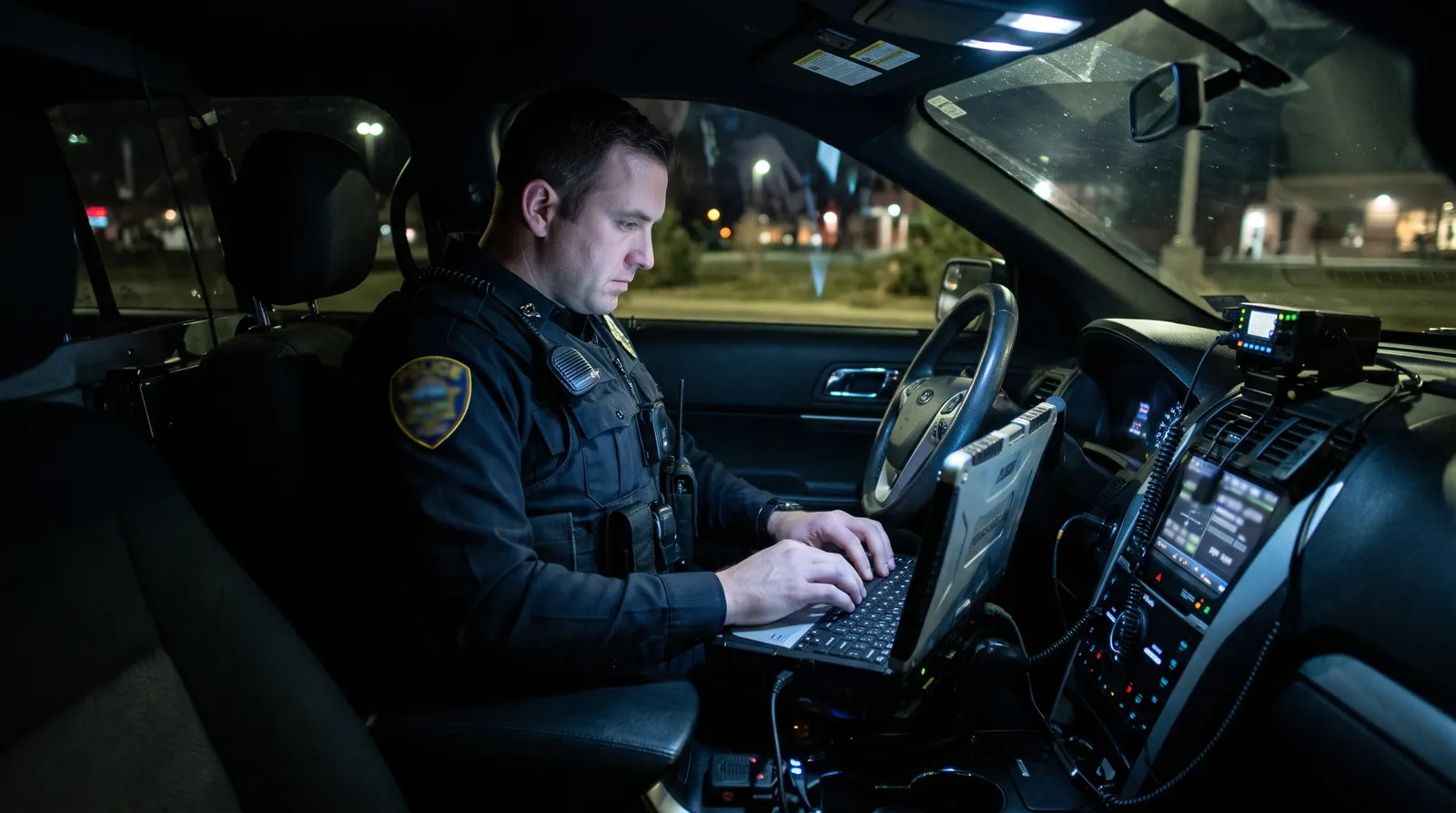
"Running" a plate means checking it against the state's registration records, the way an officer does at a traffic stop. Police do it through law enforcement databases, and that's the only kind of plate check that returns an owner's name and address on the spot. Everyone else who needs to run a license plate goes through the state agency's request form, states a purpose the DPPA permits, and waits for the answer by mail or email. An officer will run the license plate in seconds; a website that says it will run license plates for anyone is selling something else, and no one will run a plate's owner details for you legally without a permitted reason. Looking up a license plate number yourself follows the same rules. Here's how to run license plates the lawful way:
- Check that your reason is allowed. An insurance claim, a court case, a towing or impound notice, or verifying a vehicle you're buying all qualify in most states; curiosity doesn't.
- Use your state's form. The table below lists it, with the fee. Some states also accept requests from licensed private investigators acting for a permitted purpose.
- Send identification and payment. Agencies record who asked and why, which keeps running a license plate number from becoming a way to track people.
A license tag number search is the same request under another name, and so is asking how to run a tag; "tag" is what many Southern states call the plate. And if a friend offers to have someone run this license plate for you through a work database, don't: misusing a law enforcement or DMV system is a crime for the person who does it, and the DPPA lets the owner sue anyone who obtains the information for a purpose the law doesn't allow.
Can you look up a VIN by plate?
A VIN look up by plate number works the same way as an owner lookup: the VIN behind a plate is part of the registration record, so it comes through the state's request form, not a free public search. Many insurers and dealers can see it through their own systems. If you're buying the car, simply ask the seller for the VIN and check it against the dashboard, then run it through our free VIN decoder.
Can you find someone's address from their license plate?
Can you find someone's address with their license plate, or by their license plate number alone? Not as a member of the public, and not for free. You can't look up someone's address from their license plate on a website, and you can't lookup an address from a license plate at the DMV counter without a permitted use. The DPPA treats an address as personal information, alongside a name, photo and driver's license number, so a state can't release it to a stranger who only has the plate number. That's true whatever the plate is called where you live: you can't find an address from a number plate in the UK sense, find an address from a registration plate, or find an address with a license plate number in the U.S. without one of the law's permitted reasons. When you have a real reason, such as a crash or damage to your property, the address reaches you another way: police take the report and exchange the drivers' details, your insurer requests the record, or a court orders it. Sites that claim to find an address from a license plate number either sell old data that may belong to someone else or collect your payment and return nothing useful.
What about license plate lookup websites?
Search for a car plate search and you'll find dozens of sites offering instant results. Some genuinely sell vehicle history reports built from title and insurance data, which can be useful when you're buying a car. But when a site promises a check of the license plate owner's name for free, keep the law in mind: state agencies can't release owner details for curiosity, so those results don't come from an official record request. At best they come from other sources of uneven accuracy. At worst, you pay and get nothing useful.
If you want to look up a plate number for a legitimate reason, the official route in the table costs a few dollars and comes straight from the agency that issued the plate. Worried about the reverse, someone looking up yours? See what someone can do with your license plate number.
Partial plates and plate registration lookups
A partial license plate search is a job for the police, not the public: if you witnessed a crime or a hit-and-run and only caught part of the plate, report what you saw, along with the vehicle's color, make and direction. A plate registration lookup to check that your own registration is current is different: most states let you check your own record online or by mail.
How to find a license plate's details on your own vehicle
If the question is how to find a license plate number for a car you own, look at your registration card, your insurance card, or the last renewal notice from the state. If the plate was lost or stolen, report it to the police and your state agency before ordering a replacement. Want a plate that says something instead? Our custom plate designer previews personalized text and links to each state's availability check, and the registration renewal finder shows when your current plates are due.
License plate lookup FAQ
Is there a free license plate lookup that shows the owner?
Not legally for the general public. The federal Driver's Privacy Protection Act bars state motor vehicle agencies from releasing owners' names and addresses unless the requester has a permitted use, such as an insurance claim, a court case or a towing notice.
Can police look up a license plate?
Yes. Use by a government agency, including law enforcement, carrying out its functions is a permitted use under 18 U.S.C. 2721(b)(1). That's why reporting a crash or a hit-and-run to the police is the right first step.
What happens if someone gets owner information illegally?
Under 18 U.S.C. 2724, a person who knowingly obtains, discloses or uses personal information from a motor vehicle record for a purpose the law doesn't permit can be sued by the owner for actual damages of at least $2,500, plus possible punitive damages and legal costs.
How much does a vehicle record request cost?
It varies by state, from about $1 in Georgia, Oklahoma and Tennessee to $15 in Michigan, Kansas, New Jersey and Pennsylvania, $20 in Connecticut and New Hampshire, and $25 in Delaware.
Sources
- 18 U.S.C. 2721, Prohibition on release and use of personal information from state motor vehicle records
- 18 U.S.C. 2724, Civil action
- U.S. Department of Justice: Approved NMVTIS data providers
Each state's form and fee comes from that agency's own website or form; the tool links to the exact page. This guide is general information, not legal advice.