How to Write a Bill of Sale for a Vehicle
A bill of sale is a one-page record of a private sale, and you don't need a lawyer or a special form to make one. This guide shows how to write a bill of sale for a car, truck or motorcycle: what to put in it, wording you can copy, what a few states insist on, and the mistakes that cause trouble at the DMV.

Write down who sold the vehicle to whom, which vehicle it was (year, make, model, VIN), the mileage, the price and date, how it was paid, and that it's sold as-is. Make two copies and have both people sign each one. That's a complete vehicle bill of sale in most states.
What a bill of sale does, and what it doesn't
A bill of sale is proof that a sale happened on agreed terms. It records the price, which several states use to work out the buyer's tax, and the date, which shows when responsibility for the car passed to the buyer. It's also the document you reach for if the buyer later claims you promised something you didn't.
What it doesn't do, for a titled car, is transfer ownership. That's the title's job. The buyer still needs the signed title to register the car, and in most states a bill of sale alone won't get them one. Think of the title as the deed and the bill of sale as the receipt; our guide on whether a bill of sale is the same as a title goes deeper.
What to write on a bill of sale
Whether you type it or write it by hand, include these nine things:
- The seller's full name and address, exactly as on their ID and the title.
- The buyer's full name and address.
- The vehicle: year, make, model, body style and color.
- The VIN, all 17 characters, copied from the car or the title and checked twice.
- The odometer reading on the day of the sale.
- The sale price, or the word "gift" if no money changes hands.
- The date of the sale and, if you like, the place.
- The terms: usually that the vehicle is sold as-is, with no warranty.
- Signatures and printed names of the seller and the buyer.
If you're wondering what a bill of sale needs to say beyond that, add anything you agreed that isn't obvious: a second set of keys, a set of winter tires, or a promise to hand over the title once the lender releases it.
How to write a bill of sale, step by step
- Gather the facts first. Have the title, both IDs and the car itself in front of you. Most errors come from typing details from memory.
- Check the VIN in two places. Compare the dashboard plate or door label with the title. Our VIN checker confirms the check digit, which catches a mistyped character.
- Write the document. Use the wording below or fill in our free bill of sale template, which arranges everything on one page.
- Read it aloud together. It takes a minute and catches a wrong price or name before anyone signs.
- Print or write two copies and sign both. Each of you keeps one original.
- Sign the title over in the right places, and photograph both documents before you part.

Sample wording you can copy
If you'd rather write out a bill of sale yourself, this wording covers what most states expect. Replace the brackets with your details:
Vehicle Bill of Sale. On [date], at [city, state], I, [seller's full name], of [seller's address], sell and transfer to [buyer's full name], of [buyer's address], the following vehicle: [year] [make] [model], [color], VIN [17 characters], with an odometer reading of [miles] miles. The buyer has paid [amount in numbers and words] by [cash, cashier's check or bank transfer], and the seller acknowledges receiving it in full. The vehicle is sold as-is, with no warranty of any kind, expressed or implied. The seller states that they own the vehicle and that it is free of liens. Seller's signature and printed name; buyer's signature and printed name; date.
Two small habits make this stronger. Write the price in both numbers and words, as on a check, so it can't be changed later. And write the VIN with clear separation between similar characters, such as 0 and D or 5 and S, since a VIN never contains the letters I, O or Q.
Variations
- A gift: replace the payment sentence with "The vehicle is given as a gift; no money has changed hands." Some states have a separate gift or relationship affidavit for tax.
- A payment plan: write the amount paid today, the balance, and when it's due. Many sellers keep the title until the final payment, and say so in writing.
- A trade: describe both vehicles and any cash difference.
- Extras: list items sold with the car, such as a hitch, a roof rack or spare tires.
Can a bill of sale be handwritten?
Yes. A handwritten bill of sale is generally just as valid as a typed one, as long as it's legible and contains everything above. Virginia DMV even describes what a handwritten bill of sale must contain: both signatures, the price, the year, make and model, the VIN and the date. Here's how to write a handwritten bill of sale that holds up: use ink, write in capital letters for names and the VIN, and avoid crossing out. If you make a mistake, start a fresh sheet rather than correcting it.
Our template has a "print a blank copy" option if you'd like the layout without typing, so you can fill it in by hand beside the car.
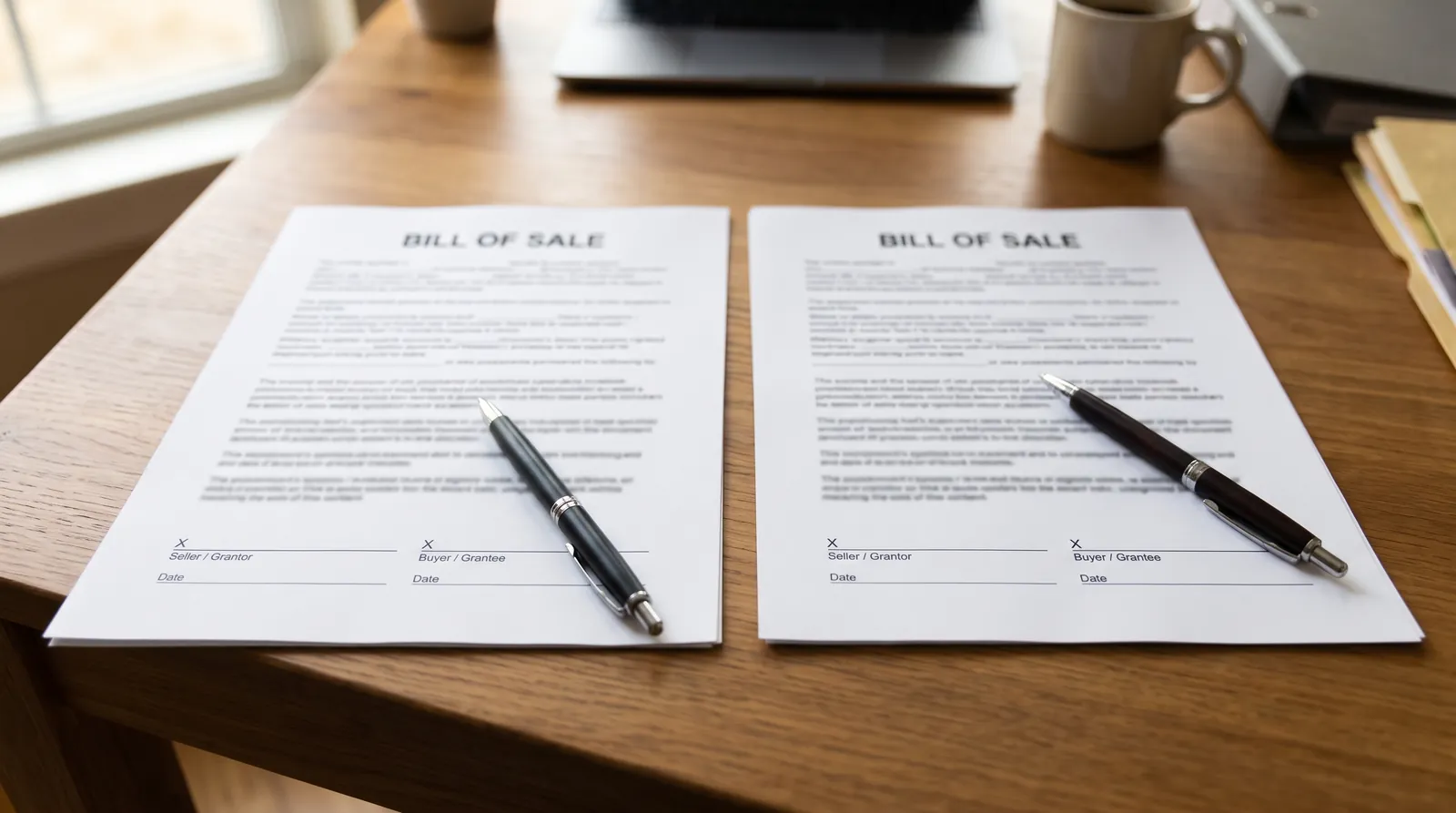
How do you fill out a bill of sale form?
If your state publishes its own form, or you've printed a blank template, the job is filling in boxes rather than writing sentences. Work top to bottom and leave nothing empty: if a line doesn't apply, write "none" or draw a single line through it, so nobody can add something later. Copy the vehicle details from the title, not from the listing, and write the date of the handover, not the date you agreed the price.
State forms often add a box or two of their own. Connecticut's H-31 and New York's MV-912 are short, one-purpose forms; others combine the bill of sale with an odometer statement or a tax section. Read the whole form once before you write anything, because some ask the buyer to sign in a place you might not expect.
And if you're asking how do I write up a bill of sale when the state has no form at all, the answer is the sample wording above: any clear document with the required details works.
Motorcycles, boats and trailers
The same nine items apply, with a few additions. A motorcycle bill of sale should show the engine number as well as the VIN, since many bikes have both stamped on the frame and engine. A boat has a 12-character hull identification number instead of a VIN, and when the motor and trailer go with it, each should be listed separately with its own serial number, because a trailer is a road vehicle registered on its own. For a trailer, add the empty weight if your state titles trailers by weight. Our templates for each type ask for these details so you don't have to remember them.
After you've written it
Give the buyer one signed original and keep the other with a photo of the signed title. Then report the sale if your state has a seller's notice: California wants a release of liability within 5 days, and Wisconsin asks sellers to report within 30. Remove your plates if your state keeps them with the owner, and cancel your insurance only once the buyer has driven away. If anything goes wrong later, such as a parking ticket on a car you've sold, the bill of sale is your proof of the date.
What some states require
Most states accept any bill of sale that's complete and signed, but several spell out what it must contain or when it's needed:
- Virginia: a handwritten bill of sale must be signed by both seller and buyer and show the price, year, make, model, VIN and date. See our Virginia car bill of sale.
- Connecticut: required to register a car; DMV lists both parties' names and addresses, the vehicle description and VIN, the price, the date and the seller's signature. See our Connecticut bill of sale.
- Washington: required unless the price and date are already on the title. See our Washington bill of sale.
- Wisconsin: optional, but WisDOT suggests including both parties' phone numbers as well as the usual details. See our Wisconsin car bill of sale.
- Indiana: the BMV lists the buyer's name, the year, make and model, and the seller's signature and address. See our Indiana bill of sale.
- New York: DMV's form MV-912 must be signed by the buyer too, even for a gift. See our New York vehicle bill of sale.
- Massachusetts: needed when the title has no space for the price, or for a vehicle exempt from titling because of its age. See our Massachusetts bill of sale.
We have state versions for 14 states in our bill of sale library, each with the state's own requirements built in.
Does a bill of sale need to be notarized?
In most states, no. The exceptions are specific. West Virginia asks for a notarized bill of sale, signed by both parties, when a private sale price is under half of the vehicle's low book value. Louisiana accepts a notarized bill of sale as an alternative to assigning the title in front of a notary. If you're not sure, adding a notary costs little and never hurts; our template has an optional notary block.
Mistakes to avoid
- Writing a lower price than you were paid. Several states compare the price with book value anyway, and a false price on a signed document creates its own problems.
- Leaving out the VIN or the mileage. Without them, the document doesn't clearly identify the car.
- Only one copy. If the buyer has the only signed copy, you have no proof of the date you sold it.
- Promising things you can't keep. Anything you write, such as "runs perfectly," can become a warranty. Stick to facts and the as-is clause.
- Treating it as a substitute for the title. If the title is missing, replace it before the sale; see how to replace a lost car title, or, if you're the buyer, what to do when a car has no title.
The faster way
If you'd rather not draft it from scratch, our free vehicle bill of sale generator asks for each item above, checks the VIN as you type, adds the as-is wording and an odometer statement, and prints on one page or saves a PDF. Nothing you type leaves your browser. There are separate templates for motorcycles, boats and trailers, since each needs different details.
Writing a bill of sale: FAQ
Can a bill of sale be handwritten?
Yes. A handwritten bill of sale is generally as valid as a typed one if it's legible, complete and signed. Virginia DMV, for example, describes what a handwritten bill of sale must include.
What should a vehicle bill of sale say?
The buyer's and seller's names and addresses, the year, make, model and VIN, the odometer reading, the price and date, how it was paid, whether it's sold as-is, and the signatures. Some states require specific items on this list.
Does a bill of sale need to be notarized?
Usually not. A few states ask for a notarized bill of sale in particular situations, such as West Virginia when the price is under half the low book value, or Louisiana as an alternative to a notarized title assignment.
Does a bill of sale replace the title?
No. For a titled vehicle, the signed title transfers ownership. The bill of sale records the price, date and terms of the deal.
Sources
- Virginia DMV: Buying or selling a vehicle
- Connecticut DMV: Get a vehicle bill of sale
- WisDOT: Sell your vehicle
- Indiana BMV: Bill of sale as proof of ownership
- New York DMV: Buy, sell or transfer ownership
- Washington, Massachusetts, West Virginia and Louisiana: see the sources on our state pages and the bill of sale guide.
This guide is general information, not legal advice. For a sale with unusual terms, such as a long payment plan, consider having a lawyer review the agreement.