What do you need to transfer a title, and why does it matter so much? A title transfer is the legal step that moves a vehicle's ownership from one person to another. The bill of sale records the deal, but it's the title, signed over and processed by the state, that makes the new owner the owner. Get it wrong and the buyer can't register the car, or the seller keeps getting the buyer's parking tickets. After the transfer, our registration renewal finder shows when and where the new owner renews.
The trouble is that every state does it a little differently. One wants a notary, another wants the seller to file a notice within five days, a third gives the buyer two months. We read the official pages for all 50 states and Washington, D.C., and put what they say into the checklist builder above. Where an agency's own pages don't state something, the checklist says so instead of guessing.
What do you need to transfer a title? The short list
Across almost every state, a private-sale title transfer comes down to the same set of documents. If you're wondering what you need to transfer a car title before you start, it's this:
- The original title, signed over by every owner named on it. Copies aren't accepted.
- The odometer reading on the title, for vehicles from model year 2011 on that are under 20 years old.
- A lien release, if the title shows a lender.
- A bill of sale, which many states require and all of them accept as proof of the price.
- Your state's title application, such as Form 130-U in Texas or the MV-82 vehicle registration/title application in New York.
- ID, proof of insurance and payment for the title fee and any sales or use tax.
- Extras some states add: a notary stamp, a safety or emissions inspection, a VIN inspection for out-of-state vehicles, or a separate seller's notice. Our VIN verification guide explains that inspection state by state.
So what do I need for a title transfer in my own state? That's where the checklist builder comes in. It fills in the state-specific parts: what you need to switch a car title where you live, which office handles it, and how long you have.
How a title transfer works, step by step
For the seller
- Find the title. If it's lost, apply for a duplicate before you sell; most states won't move ownership without it.
- Clear any loan. The lender has to release the lien.
- Sign it over. Fill in the buyer's name and address, the date, the price where there's a space and the odometer reading, then sign exactly as your name is printed. In states that require it, sign in front of a notary.
- Give the buyer a bill of sale and keep a copy.
- Report the sale. Many states have a notice of sale or release of liability: California wants it within 5 days, Arizona within 10, Washington within 5 business days.
- Deal with the plates the way your state expects.
For the buyer
- Check the title before paying. The seller's name should match their ID, and there should be no unreleased lien.
- Watch the seller sign. Don't accept a title with the buyer's name left blank. Georgia makes delivering or accepting a title assigned in blank a misdemeanor.
- Get insurance before you drive away. A title-only transfer may not need it, but registration does; see insurance and title transfers.
- Apply for your title at the right office, with the right form, before the deadline.
Title transfer deadlines and offices by state
This table summarizes what each state's agency says about where the buyer applies and how long they have. Choose your state in the tool for the full checklist, including seller duties and notary rules. Once you've filed, our guide on how long a title transfer takes explains the wait.
| State | Where the buyer applies | Deadline |
|---|---|---|
| Alabama | your county's license office | Register within 20 calendar days of acquiring the vehicle to avoid penalties and interest. |
| Alaska | a DMV office | Not stated on the pages we checked; ask the agency |
| Arizona | an MVD office | Apply for the new title within 15 days of purchase or a penalty may apply. |
| Arkansas | a state revenue office | Title and register cars, trucks and motorcycles within 60 calendar days of the transfer (30 days for trailers, ATVs and motorboats). |
| California | a DMV office | Transfer ownership within 10 days of buying the vehicle. |
| Colorado | your county motor vehicle office | Title and register within 60 days of purchase; late fees are $25 a month, up to $100. |
| Connecticut | a DMV office | Not stated on the pages we checked; ask the agency |
| Delaware | a DMV facility, ideally with the seller | Apply for the new title within 30 days of purchase to avoid a penalty fee. |
| District of Columbia | a DC DMV service center, or online with the original title mailed in | Not stated on the pages we checked; ask the agency |
| Florida | a motor vehicle service center | Transfer within 30 calendar days to avoid a late penalty. |
| Georgia | your County Tag Office | The DOR's casual-sale page says to complete title and registration within 7 days of purchase. |
| Hawaii | a satellite city hall (Honolulu) | In Honolulu, transfer within 30 days of the transfer date on the title, or a $50 penalty is added. |
| Idaho | a county assessor's motor vehicle office | File within 30 days of the transfer to avoid a late-filing penalty. |
| Illinois | a Secretary of State facility | Put the title in your name within 20 days of buying from a private seller. |
| Indiana | a BMV branch | Apply within 45 days of buying the vehicle, or an administrative penalty applies. |
| Iowa | any county treasurer's office | Not stated on the pages we checked; ask the agency |
| Kansas | the county treasurer's motor vehicle office where the vehicle will be kept | Apply within 60 days of purchase; penalties start on the 61st day. |
| Kentucky | your county clerk's office | The title must be transferred to the new owner within 15 days of the sale. |
| Louisiana | an OMV office | Not stated on the pages we checked; ask the agency |
| Maine | your town or city office, then the town office or a BMV branch to register | Not stated on the pages we checked; ask the agency |
| Maryland | an MVA branch | Not stated on the pages we checked; ask the agency |
| Massachusetts | an RMV Service Center, after a licensed insurance agent stamps your application | File within 10 days of buying the vehicle. |
| Michigan | a Secretary of State office | Transfer within 15 days of the sale or a $15 late fee applies. |
| Minnesota | a deputy registrar office | Transfer ownership on the title within 10 days of the sale. |
| Mississippi | your county tax collector's office | Not stated on the pages we checked; ask the agency |
| Missouri | a license office | Title within 30 days of purchase; a $25 penalty starts on day 31 and grows to a maximum of $200. |
| Montana | the county treasurer's office in your county of residence | Apply within 40 days of the sale date; a $10 late fee applies after that. |
| Nebraska | a county treasurer's office | The title must be issued within 30 days of the purchase date. |
| Nevada | a DMV office | Register the vehicle within 30 days of purchase. |
| New Hampshire | your town or city clerk's office | Not stated on the pages we checked; ask the agency |
| New Jersey | a motor vehicle agency | Transfer within 10 working days of the sale to avoid a $25 penalty. |
| New Mexico | an MVD office | A $20 late fee applies if you apply more than 30 days after the transfer. |
| New York | a DMV office | Not stated on the pages we checked; ask the agency |
| North Carolina | a license plate agency | Not stated on the pages we checked; ask the agency |
| North Dakota | North Dakota DOT, Motor Vehicle Division | Submit the title for transfer within 30 days of receiving it. |
| Ohio | a county Clerk of Courts title office | Transfer within 30 days of the sale or a late fee applies. |
| Oklahoma | Service Oklahoma or a licensed operator | Transfer the title within 30 days of the assignment date to avoid penalties. |
| Oregon | a DMV office | Apply for the title within 30 days; late fees are $25 (31 to 60 days) and $50 after 60 days. |
| Pennsylvania | an authorized PennDOT agent | Submit the paperwork within 20 days of the sale. |
| Rhode Island | a DMV office | Not stated on the pages we checked; ask the agency |
| South Carolina | an SCDMV branch, or by mail | Not stated on the pages we checked; ask the agency |
| South Dakota | your county treasurer | Apply within 45 days of purchase; interest and penalties apply after that. |
| Tennessee | your county clerk's office | Not stated on the pages we checked; ask the agency |
| Texas | your county tax assessor-collector's office | Title the vehicle in your name within 30 days of the sale. |
| Utah | a DMV office | Not stated on the pages we checked; ask the agency |
| Vermont | the DMV | Not stated on the pages we checked; ask the agency |
| Virginia | Virginia DMV | Apply for a title within 30 days of purchase. |
| Washington | a vehicle licensing office | Transfer within 15 days; a $50 penalty starts on day 16, plus $2 a day, up to $125. |
| West Virginia | West Virginia DMV | Not stated on the pages we checked; ask the agency |
| Wisconsin | online through eMV Public, or a DMV service center | If the vehicle will be driven, title and register it within two business days after purchase. |
| Wyoming | your county clerk's office | Not stated on the pages we checked; ask the agency |
A few patterns stand out. Thirty days is the most common window. Michigan and Washington give 15 days, Massachusetts and Minnesota 10, and New Jersey 10 working days. Colorado and Kansas are generous at 60. Wisconsin is the strictest: if the vehicle will be driven, the buyer should title and register it within two business days. Where we've written "not stated," the agency's own pages we checked don't give a number, so ask before you assume.
Some states also have dedicated pages for the most common local questions. We have detailed guides for an Illinois title transfer, a California title transfer, a Michigan title transfer and the Washington title application.
Replacement fees vary more than most people expect. A duplicate costs $4 in Arizona, $8.20 in Colorado, $10 in Arkansas, $15 by mail in Indiana and $20 in Wisconsin. New Jersey charges $60 and Pennsylvania $72 by mail. South Carolina takes requests online, and Louisiana needs a signed affidavit on its vehicle application.
Notes for a few states people ask about most
- Georgia (GA): the GA title application is the MV-1, filed at the County Tag Office. For a title transfer in GA after a private sale, the Department of Revenue's casual-sale page says to complete title and registration within 7 days. Moving a car titled in another state to Georgia follows the same MV-1 process, with an inspection certificate (T-22B) if the vehicle wasn't registered in Georgia before.
- North Carolina (NC): an auto title transfer in NC needs the title notarized when it's signed over, plus the MVR-1 title application, the MVR-180 odometer statement and the MVR-181 damage disclosure.
- Texas: the Texas title application form is Form 130-U, filed with the county tax assessor-collector within 30 days. Our Texas title guide covers that and replacing a lost Texas title, and the Texas bill of sale records the sale itself.
- Indiana: an Indiana BMV title transfer uses State Form 205, filed at a branch within 45 days.
- New Mexico (NM): the NM title application is the MVD-10002; a $20 late fee applies after 30 days.
- Maryland (MD) and South Carolina (SC): the MD title application is the VR-005; the SC title application is Form 400.
Which states need a notary for a title transfer?
Most don't. A notary title transfer is the exception, but the states that require it are strict about it, and an unnotarized title in those states will be sent back. From the agencies' own pages:
- Kentucky: the seller signs the back of the title in front of a notary.
- Louisiana: the title is assigned before a notary, or a notarized bill of sale is provided.
- North Carolina: a North Carolina title must be notarized when it's signed over.
- Ohio: the seller's signature on the title is notarized.
- Oklahoma: a paper Oklahoma title must be properly assigned and notarized.
- Pennsylvania: the seller's signature must be notarized or verified, usually at an authorized PennDOT agent.
- West Virginia: a notarized bill of sale is needed if less than half of the low book value was paid.
Montana used to require notarization too, but its Motor Vehicle Division says HB165 removed the requirement for individuals as of October 2, 2025. If you're doing a car title transfer in a notary state, sign in front of the notary, not at home beforehand; a notary can't stamp a signature they didn't witness. Arrange the car title transfer notary before the buyer arrives, so the sale doesn't stall on the day.
How to sign a title correctly
Title signing goes wrong more often than any other step. Before anyone signs title paperwork, read the back of the certificate: there's a seller's line, a buyer's line, an odometer section and, on many titles, a space for the price. The seller signs exactly as their name is printed on the front; our guide to where to sign a title when selling a car goes through every line. In a notary state, the car title signature has to happen in front of the notary, so a notarized title can't be prepared in advance; a vehicle title notary will only stamp what they watch you sign. Bring photo ID, since the notary checks it before notarizing a vehicle title.
Be wary of buying a car with the title already signed by someone who isn't the seller in front of you. That's often a sign the car was bought and resold without being retitled, which several states prohibit. The name in the seller's section should match the person you're paying and their ID.
How to transfer a car title to a family member
Giving a car to your child, spouse or parent is still a title transfer. The seller (the giver) signs the title over, the receiver applies for a new title, and the price is written as a gift. The differences are usually about tax: many states charge less, or nothing, on transfers between close relatives, but you normally have to prove the relationship or sign a statement. Two examples from the agencies' pages: Tennessee has an Affidavit of Non-Dealer Transfers for gifts and transfers between close relatives, and Mississippi asks related buyers and sellers to complete an Affidavit of Relationship.
So if you're working out how to transfer a car title to a family member in your state, start with the gift rules. Choose "gift or family transfer" in the tool and the checklist adds a reminder to ask about those forms. A bill of sale with the gift box ticked is useful here too, because it records that no money changed hands.
Title transfer from out of state
Moving to a new state, or buying a car titled somewhere else, means swapping the old title for a new one, and then registering it; our vehicle registration guide covers that second step. An out of state title transfer usually needs more than an in-state sale:
- A VIN inspection. Kansas requires a vehicle inspection when the title came from another state, and Rhode Island requires a VIN inspection by local police for vehicles coming from out of state.
- The out-of-state title itself, or cooperation from the lender who holds it.
- A new-resident deadline. For example, Iowa and Maine give new residents 30 days, while DC, Maryland and Utah give 60.
Whether the car is heading to Ohio, New Jersey, Pennsylvania or Indiana, the answer is the same: start with the state where the car will be registered, because it's that state's rules that apply. For a Georgia title transfer out of state, the MV-1 and a T-22B inspection certificate are the key forms. Pick your new state in the tool and choose "moving here."
Selling or buying a car with no title
A car with no title is the most common reason a sale stalls. For a vehicle the state titles, the title is the proof of ownership, so a no title car sale leaves the buyer unable to register it. What to do depends on who's missing the paper.
If you're the owner and the title is missing
Replace it before you sell. Every state issues duplicates, and many are cheap: $4 in Arizona, $8 in Georgia, $10 in Arkansas, $20 in Wisconsin. Some take requests online. Trying to sell a car without title paperwork, with only a bill of sale, usually just moves the problem to the buyer. If you've already sold the car without the title, contact the buyer, apply for the duplicate, and sign it over as soon as it arrives.
If you're buying and the seller has no title
Don't pay until the seller has a title in their name. Without one, you can't register a car without title proof in most states, and you can't apply for the seller's duplicate yourself. A few states have narrow fallbacks: Indiana's Affidavit of Ownership for some vehicles worth $5,000 or less, and court-ordered titles. Many states also offer a bonded title, backed by a surety bond, for owners who can't get the original. Each of these takes weeks and paperwork, so treat "no title, just a bill of sale" as a serious warning sign. Our guide to registering a car without a title goes through each route.
A bonded title follows a similar pattern wherever it's offered. You buy a surety bond, with the amount usually tied to the vehicle's value, and apply with evidence of how you came to own it. The state then issues a title with a bonded notation for a period it sets. If nobody comes forward with a better claim during that time, the notation drops off and the title becomes an ordinary one. Ask the agency for its bond amount and waiting period before buying a bond, because both differ from state to state.
Older vehicles that never had a title
Some states don't title older vehicles at all. New York doesn't issue titles for model year 1972 and older; a transferable registration and a bill of sale move ownership instead. Massachusetts accepts the previous owner's registration and a bill of sale for vehicles exempt from titling because of their age. So a missing title can be normal for a classic car, but only in a state whose rules say so. Confirm the model-year cutoff with the agency before you pay, because it differs between states and a few have changed theirs over the years. Ask the seller for the old registration and any earlier bills of sale too; for an untitled vehicle, that paper trail is the only history you will get.
Getting a replacement title for a car
To get a replacement car title, apply to the agency in the state that issued it, not the state you live in now. Our guide to how to replace a lost car title lists the form and fee in 24 states. The owner on record applies, usually with ID, the state's application and the fee. If a paid-off loan still shows on the record, include the lender's release, or the duplicate may be mailed to the lender. Our state pages walk through each process, and the tool above adds a reminder when you tick "the title is lost." Processing times range from a few days online to several weeks by mail, so if a buyer is waiting, ask whether the agency offers expedited service or whether an in-person visit is quicker than posting the application.
Never received car title from dealership paperwork after buying? Because the dealer applies for the title, ask them first for the application date and any tracking. If you titled the car yourself and it never arrived, several states replace it free if you act quickly: Pennsylvania within 90 days of the issue date, Georgia within 60 days, and Louisiana within 60 days. After that, a never received vehicle title is handled like any other replacement.
Title vs registration, and other title terms
The difference: the title proves who owns the vehicle; the registration lets it be driven on public roads and is renewed regularly. You can own a car with a title that isn't registered, but you can't register a titled car without being its owner on record.
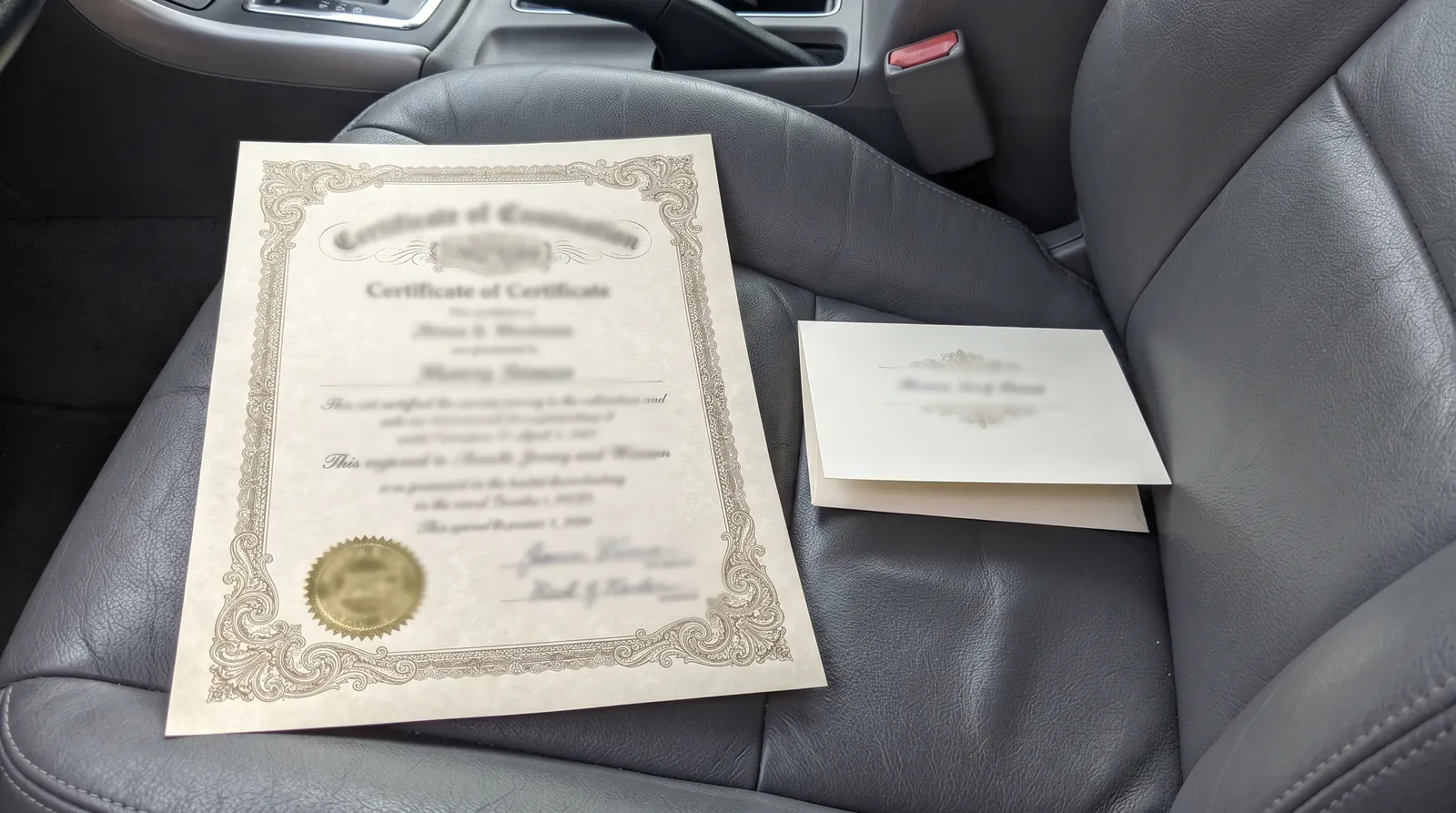
Certificate of origin vs title: a new vehicle starts with a manufacturer's certificate of origin, which the dealer uses to apply for the first state title. After that, the state's certificate of title is the ownership document. "Certificate of title" is simply the full name of what everyone calls the title.
Original title, duplicate and certified title: the original is the first one issued to the current owner. A duplicate or replacement title replaces it and voids the original. A certified copy, or certified record, is an official copy of the record from the agency, used in court or for history, and it can't be used to sell the car.
Title types: the common car title types are clean, salvage, rebuilt (or reconstructed) and junk or non-repairable, plus brands such as flood. A clean title on a car means the state hasn't branded it as a total loss or with another serious history. A salvage title means an insurer declared it a total loss; a rebuilt title means it was repaired and passed the state's inspection. The same vehicle title types apply to RVs and motorcycles.
Title number: what's a title number? (Our guide to finding your car title number covers it in detail.) It's the document number the state prints on the certificate, separate from the VIN, which our VIN location guide helps you find on the car itself. Agencies ask for it on replacement and record requests, so note it somewhere safe.
A printable title transfer sheet
Once you know what you need to transfer a title, it helps to have it on paper. The checklist is designed to print. Press "Print or save the checklist" and you get a one-page title transfer sheet with tick boxes, the agency's details and the official link, ready to bring to the office. Save it as a PDF if you'd rather keep it on your phone.
What is a title transfer sheet good for? Mostly for avoiding a second trip. Clerks turn people away for missing signatures, a missing lien release or the wrong form far more often than for anything complicated.
Mistakes that hold up a title transfer
- Signing in the wrong place. Titles have several signature lines; the seller signs only in the seller's section.
- Crossing out or using correction fluid. Alterations can void a title. If you make a mistake, ask the agency how to correct it.
- Missing a co-owner. If two owners are listed with "and," both usually sign. Need to remove name from car title records when two owners are listed? That is itself a transfer: both sign, and a new title is issued in the remaining name, as our Colorado title guide and our step-by-step guide to taking a co-owner off a title explain.
- An unreleased lien. Even a paid-off loan needs a release on paper or in the state's system.
- Waiting too long. Late fees start quickly in some states: $15 in Michigan after 15 days, $50 in Washington from day 16.
Title transfer FAQ
What do you need to transfer a title?
Usually the original title signed over by every owner, the odometer reading where required, a lien release if a loan is shown, a bill of sale, your ID, proof of insurance, your state's title application and payment for fees and tax. Some states also need a notary, an inspection or extra forms.
Does a title transfer need a notary?
Only in some states. Kentucky, North Carolina, Ohio and Oklahoma require the seller's signature on a paper title to be notarized, and Pennsylvania requires it to be notarized or verified. Montana dropped its notary requirement for individuals on October 2, 2025. Most states don't require one.
How long do I have to transfer a title after buying a car?
It depends on the state, from as little as two business days in Wisconsin (if the vehicle will be driven) to 60 days in Colorado and Kansas. Many states use 30 days. Missing the deadline usually means a late fee.
Can I transfer a car title to a family member?
Yes. The steps are the same as a sale, but the price is written as a gift. Some states have a gift or family-transfer affidavit; Tennessee, for example, has an Affidavit of Non-Dealer Transfers, and Mississippi asks relatives to complete an Affidavit of Relationship.
Sources
Each state's facts come from its motor vehicle agency's website; the checklist links to the exact page for the state you choose. Federal odometer rules: 49 CFR Part 580.
This page explains common rules and is not legal advice. Title rules change; your state's motor vehicle agency has the final word.