License Plate Colors and Types, From the US Government License Plate to Black Plates
Most plate colors are just a state's design choice, but a few carry real meaning. A US government license plate means a federal vehicle, a yellow plate with red letters in Ohio means a court order, and an "apportioned" truck plate means the truck crosses state lines. Here's how to read what you see on the road, and what the codes on foreign plates mean.
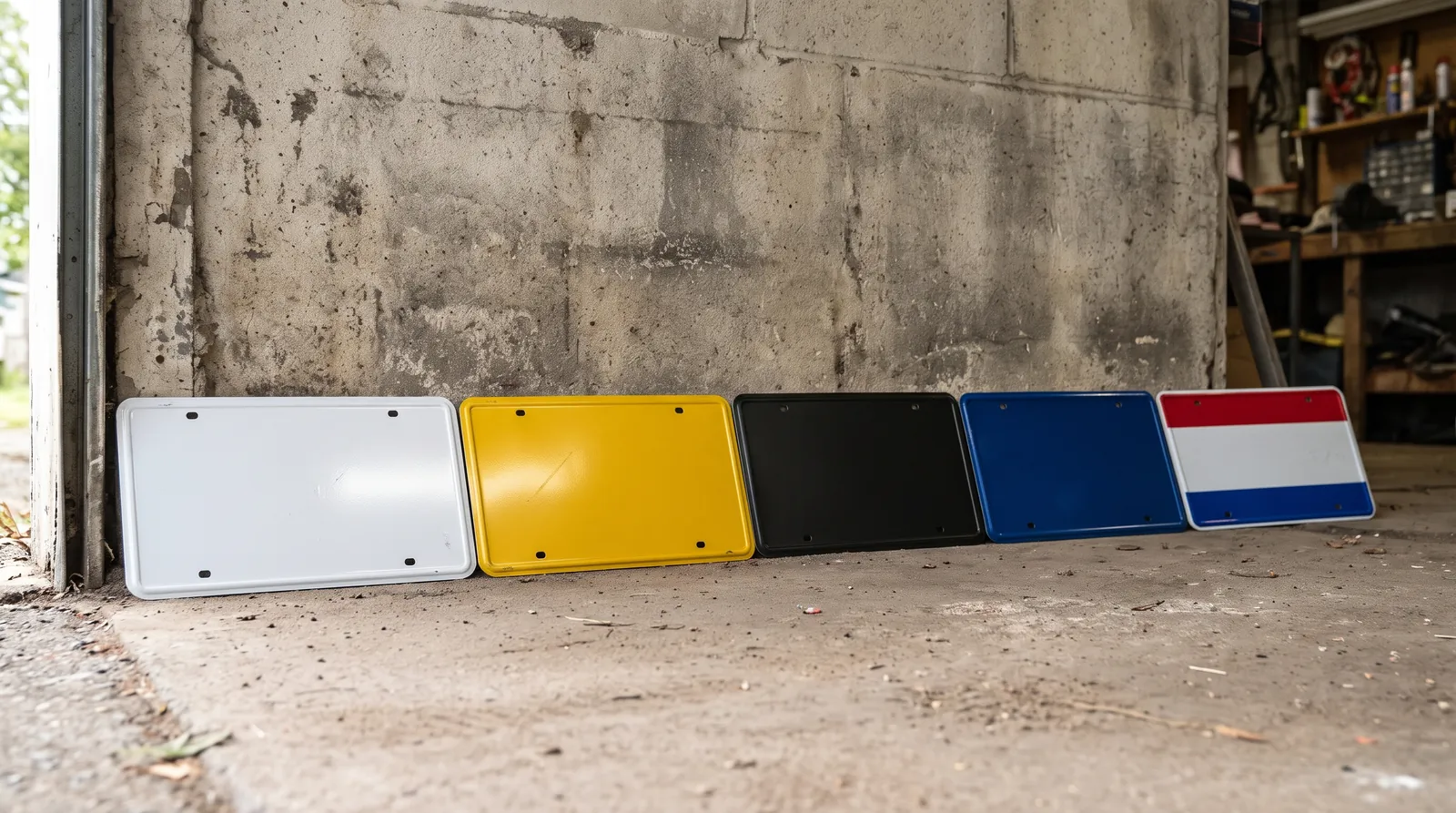
The US government license plate
Federal vehicles carry their own plates, not state ones. Federal law, 40 U.S.C. 609, requires government vehicles in the US and its territories to be clearly identified with the agency's name and purpose, and the General Services Administration runs the plate program that does it. The plates themselves are made by UNICOR, the Federal Prison Industries program, under an agreement that covers every federal agency.
Read a US government plate from the left. The number starts with a letter code that identifies the agency that owns or leases the vehicle; GSA Fleet's leased vehicles, for example, use the prefix G. Each plate belongs to a single vehicle and can't be moved to another one, and the rules forbid using them on private cars. GSA has also begun moving agencies to plates without expiration dates as old ones expire.
US government license plate meaning in practice
A car with US gov plates isn't registered with any state; it's recorded in GSA's own fleet registration system instead. That's why a federal vehicle has no state sticker. A few federal vehicles don't carry these plates at all. Cars used for investigations, law enforcement, intelligence or security work can be exempt when marking them would get in the way, and those are registered under ordinary state law.
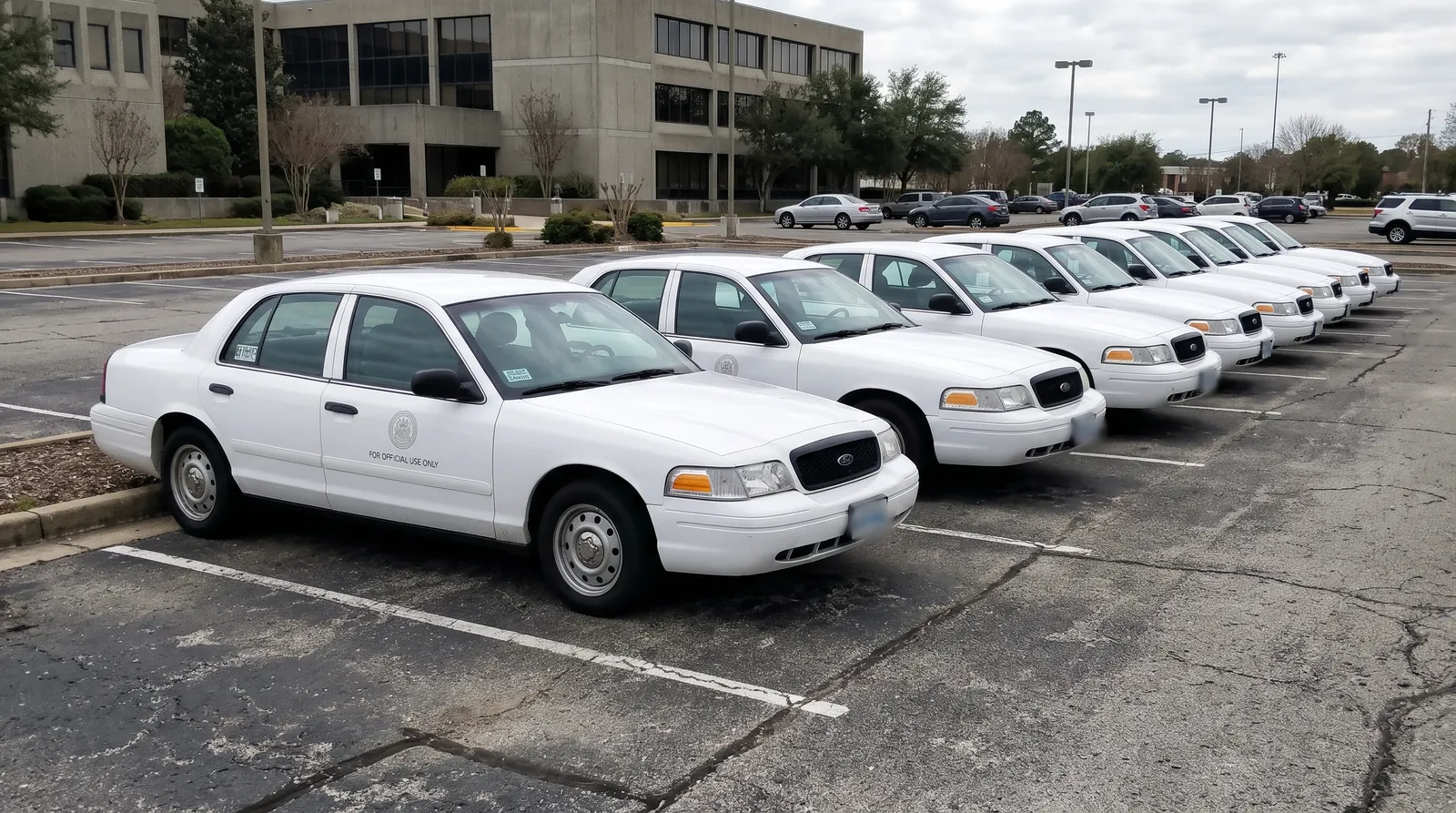
State and city government plates
Vehicles owned by states, counties and cities are a different category. Many states issue them special "exempt" or government plates, because public agencies don't pay registration fees the way private owners do. The design varies by state, but the plate usually says exempt, official or the agency's name, so it's easy to tell from a private car.
What the characters on a US plate tell you
On an ordinary passenger plate, the letters and numbers are usually just a sequence. States hand them out in order as new registrations come in, so a plate doesn't tell you who owns the car or where they live. A few states add more information around the edges. Tennessee and Georgia, for example, show the county the vehicle is registered in, and many states print a slogan, a website address or the plate type along the bottom.
The sticker is the part police actually check. It shows when the registration expires, usually by month and year, and its color changes from year to year in many states. If a plate has no sticker at all, the state may simply not use them any more; several have moved to electronic records and dropped stickers for most vehicles.
Personalized plates are the exception to the sequence rule. The owner picks the characters, within limits on length and content that each state sets; our guide on how many letters fit on a plate lists them. And a plate's characters belong to the registration, not the car: when you sell, the plate may move to your next vehicle, go back to the state or go with the car, depending on where you live.
Why plates come in so many colors
Each state designs its own standard plate, and most also sell dozens of specialty plates for colleges, causes, sports teams and the military. On top of that, plates come in classes: passenger, truck, trailer, motorcycle, dealer, temporary and so on. So when you see an unusual color, it's almost always one of three things: a specialty design, a different plate class, or a plate from another state or country.
Yellow license plates
What does a yellow license plate mean?
Usually nothing more than design. Yellow backgrounds and yellow characters turn up in plenty of standard and specialty plates, past and present. California's plates from 1963 to 1969 were yellow characters on black, and from 1970 to 1980 yellow characters on blue.
The exception people ask about is Ohio. Ohio's restricted plates are yellow with red lettering, and a court can require them as a condition of limited driving privileges after certain OVI (drunk driving) offenses. A 2021 law, H.B. 388, narrowed when they're mandatory, but they still exist. People call them "party plates," though that isn't the legal name.
Yellow and black, yellow and blue
Black and yellow license plates are usually older California designs or replicas of them, and a yellow black license plate on a modern car is most likely a Legacy replica. Yellow and blue license plates are common in specialty and older standard designs in several states. Neither combination carries a special legal meaning on its own.
The yellow sticker on a license plate
If you're asking what the yellow sticker on a license plate is called, it's the registration sticker, also called a decal, tab or validation sticker. Many states change its color every year so an expired one stands out. California's year stickers in the 1960s rotated through orange, yellow, blue, pink and white.
Black license plates
Black plates are popular because they look like classic cars. In California, the 1960s Legacy plate, with yellow characters on a black background, is sold as a special interest plate for $50, sequential or personalized. California also has a Year of Manufacture program that lets owners of older vehicles register them with original plates from the car's model year.
How to get a black license plate
How do you get black license plates in a state that offers them? Start with your state's specialty plate list on the motor vehicle agency's website. If it offers a black design, order it like any specialty plate: online or at an office, with the special plate fee on top of normal registration. If your state doesn't, a black plate isn't something you can make yourself, because a plate you put on the car has to be the one the state issued. Black and white license plates are offered in some states too, often as retro or "blackout" designs.
Red plates and red letters
Red is the color states tend to use when they want a plate noticed. Ohio's restricted plates use red letters on yellow. Some states use red characters for special classes such as dealer or temporary plates. And in the UK, where a plate is also called a registration plate, red letters on a white plate mark trade plates, which motor dealers use to move unregistered vehicles. A plain red background is rare on US plates outside specialty designs, and black and red plates are nearly always a specialty design in a team's or school's colors.
Red, white and blue, and blue and white plates
A red, white and blue license plate is almost always patriotic: a veterans, military or "America" specialty design, or a state's standard plate that happens to use those colors. Blue and white plates are a standard look in several states; Pennsylvania's standard plate, for one, is white with blue characters and blue and yellow bands. If you need to know which state a plate belongs to, the state name printed on it is a better guide than the color.
Truck and trailer license plates
A truck license plate can look like a car's, but the plate class matters. Trucks that run between states under the International Registration Plan carry apportioned plates, which spread the registration fees across every state the truck drives in. Our commercial vehicle checker explains when a truck needs IRP. Light pickups used privately usually get standard passenger or light-truck plates.
A trailer license plate is often smaller and has its own number series, and in many states light trailers get a permanent or multi-year plate. Motorcycle plates are smaller still. These differences are about the vehicle class, not color.
Tags, truck tags and MC plates
In much of the South and Midwest, people say "tag" instead of plate, so truck tags, trailer tags and tag plates are simply the plates for those vehicle classes. An MC plate is a motorcycle plate, and on a form, "Lic. tag" or "LIC TAG" is shorthand for the license tag number. None of these words signals a different legal status; they're just local names.
Why some cars have only one plate
Twenty-two states issue a single plate for the back of the car, and the rest of the states plus DC want one on the front as well. So a car with a bare front bumper isn't necessarily breaking a rule; it may simply be registered in a rear-only state. In two-plate states, a decorative plate can't take the front plate's place. Our custom front plate guide lists which states are which.
Other plate types you'll see
- Dealer plates: used by licensed dealers to move and test-drive cars; they move between vehicles, unlike ordinary plates.
- Temporary tags: paper or cardboard plates issued after a sale until the permanent plates arrive.
- Disability plates: marked with the wheelchair symbol, issued to qualifying drivers.
- Antique and historic plates: for older vehicles, often with driving limits.
- Personalized and vanity plates: your own characters within the state's limits; try ideas in our custom plate designer.
License plates from other countries
Foreign plates have their own conventions, and international car plates are easier to read once you know where to look. In the European Union, most plates have a blue band on the left with the EU stars and a country code, the distinguishing sign that EU rules let drivers use instead of a separate oval sticker. In the UK, where people say number plate or licence plate, the front plate is white and the yellow number plate goes on the back, both with black characters, and since September 2021 the UK's international code has been UK rather than GB.
European license plate country codes
These EU licence plate codes, also listed as vehicle registration country codes, are the same letters you'll see on the blue band or the oval sticker:
| Code | Country | Code | Country |
|---|---|---|---|
| A | Austria | IRL | Ireland |
| B | Belgium | L | Luxembourg |
| CH | Switzerland | N | Norway |
| CZ | Czech Republic | NL | Netherlands |
| D | Germany | P | Portugal |
| DK | Denmark | PL | Poland |
| E | Spain | S | Sweden |
| F | France | SK | Slovakia |
| FIN | Finland | UK | United Kingdom |
| GR | Greece | H | Hungary |
| I | Italy | HR | Croatia |
Reading a European number plate
A blue and white licence plate from continental Europe is usually an EU plate: black characters on white, with the blue band on the left. That band is the quickest way to read number plate country codes in Europe; the letters under the stars are the EU code for the country of registration, the same codes as in the table above. Swiss and Norwegian cars aren't in the EU, so their plates may carry the country code on a separate sticker or band.
International car number plates from outside Europe follow their own designs entirely. A red, white and blue licence plate from abroad, for instance, could be a national design or a special category such as a diplomatic or temporary plate, so check the country before assuming anything. Collectors of country number plates and international license plate enthusiasts know the codes by heart, but for everyone else the sticker or band does the work.
Countries outside the EU's band system often use an oval sticker with the same kind of code, under the international road traffic conventions. A car from abroad driving in the US is registered in its home country, so its plates stay foreign for as long as it's here temporarily.
License plate colors FAQ
What does a US government license plate mean?
It marks a vehicle owned or leased by a federal agency. Federal law (40 U.S.C. 609) requires federal vehicles to be identified, and the plate's letter prefix shows which agency the vehicle belongs to; GSA Fleet vehicles use G. These vehicles aren't registered with a state.
What does a yellow license plate mean?
Usually nothing special: several states use yellow in their standard designs. In Ohio, though, yellow plates with red letters are restricted plates a court can require after certain OVI (drunk driving) offenses. In the UK, the rear plate is always yellow.
How do I get a black license plate?
Check your state's specialty plate list. California, for example, sells a 1960s Legacy plate with yellow characters on black as a special interest plate. Other states offer black specialty designs; availability and fees vary.
What is the yellow sticker on a license plate called?
It's the registration sticker, also called a decal, tab or validation sticker. Its color often changes from year to year so police can spot an expired registration.
Sources
- GSA: Desk reference guide for US Government motor vehicle license plates
- eCFR: 41 CFR 102-34 Subpart C, Identifying and registering motor vehicles
- California DMV: License plate data, 1914–1980
- California DMV: Special interest plates
- Ohio Revised Code 4510.14 (restricted plates)
- GOV.UK: Displaying number plates
This guide is general information. Plate designs and specialty programs change, so check your state's motor vehicle agency for what it issues today.